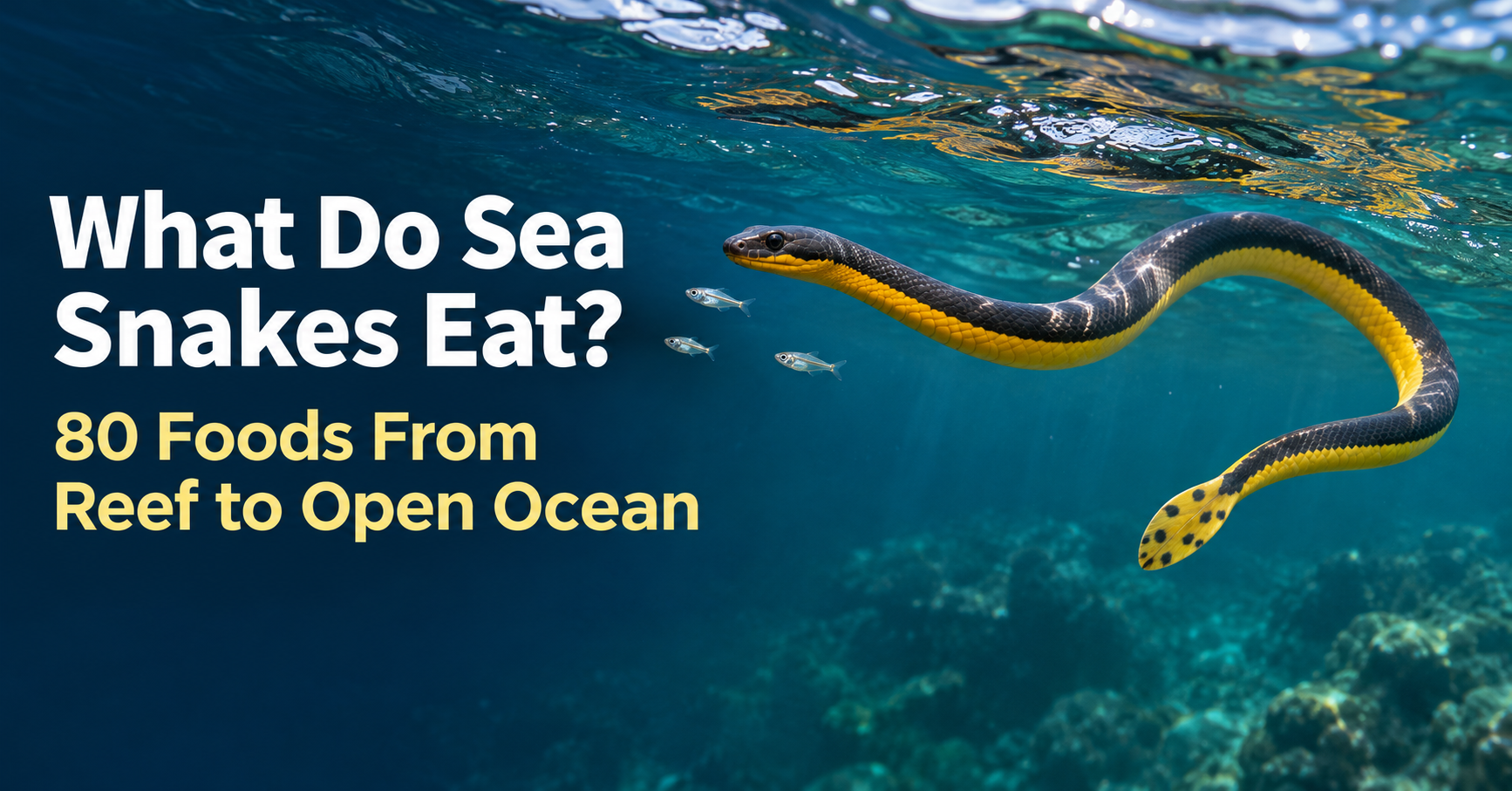
A sea snake pushing its snout into a coral crevice might emerge with a moray eel. Another snake working its way across the same reef might find a meal without catching a single fish. Its food is a patch of tiny eggs stuck to the rock. Offshore, a yellow-bellied sea snake can catch fish by lying nearly motionless at the surface and letting curious young fish swim within reach.
These are all carnivores, but they make a living in remarkably different ways. The 80 foods below span fully aquatic sea snakes and their amphibious relatives, the sea kraits. Some foods account for a large share of one predator’s meals in a particular lagoon. Others are individual records that reveal what a snake can occasionally catch. That distinction matters, especially when a fish as surprising as a yellowfin tuna appears on the list.
What do sea snakes eat in the wild?
Most sea snakes eat fish. Eels, gobies, catfish, flatfish, and small schooling fish are among their prey. Turtle-headed sea snakes specialize in fish eggs. A few species, particularly the olive sea snake, also take invertebrates such as prawns, squid, and molting crabs.
Where the snake hunts helps narrow the answer. A reef crevice can hold a moray, a sandy burrow can shelter a snake eel, and floating debris can concentrate young fish near the ocean surface. Even within one habitat, different snake species select different meals.
| Sea snake | What it eats | Where the meal comes from |
|---|---|---|
| New Caledonian sea krait | Mostly moray eels, especially the lipspot moray in one well-studied lagoon | Reef structure and other eel refuges |
| Blue-lipped sea krait | Congers, morays, snake eels, and some other fishes | A mix of soft-bottom and reef habitats |
| Turtle-headed sea snake | Eggs laid by small reef fishes | Nests attached to underwater surfaces |
| Yellow-bellied sea snake | Small fish, including the young of much larger species | Surface waters, often along lines of floating material |
| Olive sea snake | Various reef fishes and occasional invertebrates | Reef crevices and the surrounding seabed |
80 foods sea snakes eat, from the seabed to the surface
The list begins in a New Caledonian lagoon, where individual eel species can be matched to the kraits that ate them. It then moves across coastal fishing grounds, reef nests, and offshore drift lines. Where a prey fish could be identified only to a family or genus, the entry keeps that level of precision.
1. Lipspot moray eel
For the New Caledonian sea krait, Laticauda saintgironsi, the lipspot moray gives an unusually precise answer to the question of what it eats. In one lagoon comparison, this single eel species, Gymnothorax chilospilus, accounted for about 46 percent of identified prey items in that krait’s diet. Picture ten identifiable meals from that population. On average, four or five would be the same kind of moray, even though dozens of other eel species lived within hunting range.
The blue-lipped sea krait also ate lipspot morays in the lagoon, but they represented only about 4 percent of its prey items. That difference helps explain how two eel-eating reptiles can return to the same islands yet draw on different parts of the surrounding fish community. A list headed simply “eels” would miss most of what makes their diets interesting.
Lipspot morays are associated with hard reef habitat. The part of the reef that matters to a hunting krait includes the spaces beneath and between its visible surfaces. An eel can spend much of its time concealed there and still be important prey. The percentage describes the number of meals identified in this locality. It does not tell us that the same fraction of every krait’s calories, or every population’s annual diet, comes from lipspot morays.
2. Longfin African conger
The longfin African conger, Conger cinereus, was the leading named fish in the blue-lipped sea krait’s diet in the same New Caledonian comparison. It made up about 23 percent of prey items for that snake. The New Caledonian sea krait caught it too, but at a much lower frequency. The fish’s common name can be misleading here. Its distribution extends into the Indo-Pacific, and these particular meals came from the Pacific.
A conger is an eel, but it belongs to a different family from the morays. For a reader trying to picture a sea krait’s lunch, that distinction is more informative than color or banding. A conger can use shelter in a lagoon landscape that includes both hard structure and soft sediment. A snake that searches across those boundaries encounters a different set of opportunities from one concentrating on narrow fissures in reef rock.
Congers also illustrate why the largest animal in a fish identification guide makes a poor mental picture of snake prey. A species name identifies the kind of fish eaten. It does not specify the size of that individual. A sea krait swallows its prey whole, and the thickness of an eel matters as well as its length. A slender conger presents a different swallowing challenge from a deep-bodied reef fish of equal length.
3. Whitemargin moray
The whitemargin moray, Gymnothorax albimarginatus, accounted for about one in five prey items in blue-lipped sea kraits in the lagoon comparison. It was absent from the companion sample of New Caledonian sea kraits. Together, this moray and the longfin African conger accounted for more than two-fifths of the blue-lipped krait’s identified meals there.
The whitemargin moray is especially interesting because it complicates the familiar image of a moray with its head protruding from a coral cave. This species is associated with soft-bottom habitat. A lagoon with sandy areas, sediment, scattered rocks, and coral outcrops has several distinct hunting grounds, even when it looks like one continuous blue expanse from the shore. Two snakes departing the same island can reach different prey by searching different surfaces.
Its importance also illustrates the difference between a staple and a possible food. A single eel recovered from a snake establishes that the predator can eat it. Repeated appearances accounting for a substantial share of meals make a stronger case that a local population depends on it. For someone asking what blue-lipped sea kraits usually eat in this lagoon, the whitemargin moray deserves more attention than a spectacular reef eel known from just an occasional meal.
4. Moluccan moray
Gymnothorax moluccensis occurred in both New Caledonian krait diets. It accounted for roughly 8 percent of prey items for the blue-lipped sea krait and well under 1 percent for its neighbor. The fish adds an important detail to the picture of specialization. Two predators can share a prey species while differing considerably in how often they catch it.
A useful way to read this record is to imagine watching only one feeding event. If you saw each kind of krait swallow a Moluccan moray, you might reasonably conclude that the snakes have similar diets. If you could follow many meals, you would discover the difference. The blue-lipped krait returned to this prey often enough for it to contribute meaningfully to the local diet. For the other species, the same fish represented an occasional opportunity.
Several explanations could contribute to that pattern. The snakes may search different patches, encounter different sizes of fish, or reach different shelters. The meal counts alone cannot tell us which explanation applies to each capture. What they do establish is more useful than a guess about “favorite” foods. They identify a real eel, the snakes that ate it, and a place where it mattered appreciably more to one predator than to the other.
5. Richardson’s moray
Richardson’s moray, Gymnothorax richardsonii, was an uncommon but nearly equally represented food for the two New Caledonian kraits. It appeared in a little over 1 percent of prey items in each diet. That makes it a good example of genuine overlap between predators whose most frequent meals differed sharply.
This small reef-associated moray illustrates a feature of sea krait hunting that is easy to miss while snorkeling. The visible fish above a reef and the fish inside it form different communities from a predator’s point of view. A moray tucked into structure may be difficult to count on a swim across the reef. A snake capable of entering or probing its refuge has a better chance of encountering it. Which fish appear most conspicuous to people can therefore give a misleading impression of what is available to a krait.
There is also a distinction between being a small part of a snake’s diet and being unimportant to the reef. The percentage measures the share of identifiable krait prey. It does not measure the proportion of the local moray population taken by snakes. Answering that second question would require knowing how many Richardson’s morays lived there, how often the kraits fed, and how many snakes used the area.
6. Barredfin moray
The barredfin moray, Gymnothorax zonipectis, appears among meals of the New Caledonian sea krait. Its association with hard reef habitat puts it among the eels accessible to a snake that searches rock and coral structure. In the lagoon comparison it was a minor prey item, useful evidence of variety within a diet dominated by another moray.
7. Yellow-edged moray
Gymnothorax flavimarginatus is a familiar name on reef fish lists, but similarly named morays can cause confusion about what sea kraits actually eat. A distinct documented prey fish is the yellowmouth moray, Gymnothorax nudivomer, sometimes described by its conspicuous yellow mouth. The verified food in this entry is the yellowmouth moray. Blue-lipped sea kraits took it occasionally in New Caledonia. A resemblance between common names is insufficient evidence to add the yellow-edged species as another meal.
8. Fimbriated moray
The fimbriated moray, Gymnothorax fimbriatus, contributed nearly 5 percent of the New Caledonian sea krait’s prey items in the lagoon comparison. This was one of several reef-associated morays that appeared often enough to matter alongside the dominant lipspot moray. Together they show how an eel specialist can rely heavily on one prey species while still regularly catching others.
9. Undulated moray
Gymnothorax undulatus is a patterned moray associated with reef shelter. It appears among the New Caledonian sea krait’s identified meals. The record concerns individuals small enough for the krait to swallow. The substantial size that an undulated moray can attain as an adult should not be mistaken for the size of the fish actually eaten.
10. Stout moray
The stout moray, Gymnothorax eurostus, appeared in both local krait diets. It was more frequent in the New Caledonian sea krait, accounting for about 6 percent of its prey items. For this fish the interesting dimension is girth. Two eels of similar length can offer quite different meals to a predator that has to pass the entire body through its mouth.
11. Peppered moray
Gymnothorax pictus is widely called the peppered moray. Another speckled-looking eel, Gymnothorax margaritoforus, is the documented prey considered here and is more precisely called the pearl moray. It accounted for roughly one in eighteen prey items in the New Caledonian sea krait sample. The scientific name keeps a feeding record attached to the right fish when photographs or common names sound alike.
12. Pinda moray
Gymnothorax pindae was a recurring item for the New Caledonian sea krait and a rare one for the blue-lipped sea krait. Its contribution to the former was close to that of the pearl moray. Both are examples of secondary prey that collectively make up a substantial part of an eel hunter’s meals, even when one other species dominates the count.
13. Reticulate moray
Gymnothorax reticularis occurred among the blue-lipped sea krait’s prey in New Caledonia. Its association with soft bottom gives it a different ecological setting from many of the reef-crevice morays on this list. The fish is a reminder that “moray eater” and “coral-crevice hunter” describe different things. One identifies a prey family, while the other identifies a place to forage.
14. Highfin moray
Gymnothorax pseudothyrsoideus, the highfin moray, was an occasional meal of the New Caledonian sea krait. Identifying the prey to species matters because several Gymnothorax morays can inhabit the same broader lagoon. A general account that counts all of them as just one animal called a reef eel misses much of the diversity a hunting krait encounters.
15. Kidako relative Gymnothorax reevesii
This moray was recorded in both local sea krait diets, at low frequencies. The same regional prey can therefore turn up in a snake that mostly takes reef-associated morays and in one that also takes many soft-bottom fishes. Its appearance in both diets establishes shared access somewhere within their foraging ranges, without identifying the exact hiding place where either snake caught it.
16. Gymnothorax dorsalis
This moray was a rare prey item for both New Caledonian krait species. A rare record is worth retaining when the question is which animals sea snakes can eat. It deserves a smaller role when the question is what usually sustains a population. Here, a named fish documents the breadth of the diet without competing with the much stronger evidence for lipspot morays and congers as local staples.
17. Gymnothorax cribroris
This hard-bottom moray occurred in the blue-lipped sea krait sample. It adds an important qualification to the description of that snake as a hunter of soft-bottom fishes. Its common prey often came from sediment-associated habitats, yet its actual meals also included reef fish. Boundaries between hunting grounds are permeable in a lagoon with patches of coral, rubble, and sand.
18. Gymnothorax fuscomaculatus
This moray was an occasional prey fish for the New Caledonian sea krait. Its presence alongside more frequently consumed hard-bottom morays shows why a single reef feature can offer multiple feeding opportunities. A krait investigating a promising opening cannot be assumed to be tracking one particular eel species solely because that eel dominates its overall diet.
19. Dragon moray
The dragon moray, Enchelycore pardalis, is recognizable by its patterned head and elongated jaws. It also appears among meals of the New Caledonian sea krait. Here the prey is itself a predator. A food chain that begins with smaller reef animals can pass through a moray and then into a sea krait, linking two hunters that use the same complex reef structure in different ways.
20. Unicolor moray
Echidna unicolor is a distinct moray recorded from New Caledonian sea krait meals. In this context Echidna is a genus of fishes. It has no dietary connection to the spiny terrestrial mammal that shares the word as its common name. The identification is useful because it widens the list beyond the many prey morays belonging to Gymnothorax.
21. Cirrimaxilla formosa
This elusive moray was found in both krait species’ diets in New Caledonia. Hidden fishes like this one help explain why the view through a snorkel mask can differ so much from the menu of a reef predator. Sea kraits can bring evidence of fish back from hunting grounds where a person swimming overhead might never have noticed an eel.
22. Allardice’s moray
Anarchias allardicei is a small moray recorded as prey of both New Caledonian kraits. It occurred at low frequencies in each. Small, slender eels expand the range of prey available within the physical limits of swallowing whole, although the identity of this prey alone does not establish whether it was taken by a juvenile or an adult snake.
23. Canton Island moray
Anarchias cantonensis appears in meals of the New Caledonian sea krait. A geographic name can preserve the history of a species’ description without marking the limits of its range. These meals document the fish in a southwestern Pacific lagoon and distinguish it from the other small Anarchias morays that kraits caught there.
24. Seychelles moray
Anarchias seychellensis was another occasional New Caledonian sea krait prey. Its presence illustrates how much variety can be hidden under the seemingly specific answer “small morays.” Closely related fishes can share a general body plan and still represent separate prey populations with different distributions and different chances of encountering a hunting snake.
25. Tiger reef eel
The tiger reef eel, Scuticaria tigrina, occurred in the New Caledonian sea krait’s diet. It is associated with both hard and soft habitats, making it a poor candidate for an overly precise claim about capture location. Recovering the eel from a meal establishes what the snake swallowed. The fish’s usual habitat helps interpret the encounter but cannot pinpoint it.
26. Okinawa reef eel
Scuticaria okinawae was also identified in meals of the New Caledonian sea krait, less frequently than the tiger reef eel. The pair provides an example of different prey species within a single genus. Counting the two separately reflects an actual biological distinction. Adding “reef eels” as a third food on top of them would count the same meals twice.
27. Slender giant moray
The slender giant moray, Strophidon sathete, occurred occasionally in both krait diets. Its name can make the record sound implausible until the individual fish’s life stage is considered. A species that can reach an impressive maximum length also passes through much smaller sizes. The prey identification establishes the species consumed, without implying that a sea krait tackled a full-grown giant.
28. Uniform reef eel
Uropterygius concolor was recorded from both New Caledonian kraits. It belongs to a different moray genus from the lipspot and fimbriated morays. Its inclusion in both diets is particularly useful because it is associated with more than one bottom type. The eel could be available across the patchwork of hunting habitats used by the two predators.
29. Whitespotted reef eel
Uropterygius alboguttatus was an occasional prey item for the New Caledonian sea krait. Small marks that identify a well-preserved eel may disappear as digestion advances. A meal that can be assigned to a particular species therefore tells a more precise story than one recorded simply as an unidentified moray. Both types of meal still count ecologically.
30. Brownspotted reef eel
Uropterygius fuscoguttatus occurred among that krait’s hard-bottom prey. It shares a general habitat and genus with several other eels on the list. For a hunter moving through a reef, such overlap means that a productive patch can contain several potential meals, even where each individual eel species appears only rarely in the overall diet.
31. Largehead reef eel
Uropterygius macrocephalus was identified among New Caledonian sea krait meals. The prey record is more reliable than an inference based on the name or shape of the fish. Although head and body dimensions matter to a predator that swallows whole, the species name alone cannot tell us how long the snake took to handle it or which end it swallowed first.
32. Finely spotted reef eel
Uropterygius polyspilus contributed a small share of the New Caledonian sea krait’s prey. For a reef observer, the important point is the number of distinct fishes represented by superficially similar spotted eels. Pattern alone is a weak basis for naming a partially hidden meal. Here, the identification links this particular species to the snake’s diet.
33. Uropterygius supraforatus
This reef eel accounted for about 2 percent of prey items in the New Caledonian sea krait comparison. That is enough to distinguish a recurring local food from a species known solely through a single chance encounter. It also shows how numerous smaller contributions accumulate around one dominant staple in a specialist predator’s diet.
34. Uropterygius xanthopterus
This moray was a rare food of the same krait. It belongs on a list of documented prey, although there is little basis for claims about how frequently any particular individual snake seeks it. An uncommon eel in the diet could be scarce, difficult to reach, suitable only at certain sizes, or encountered infrequently for several reasons together.
35. Spotted snake eel
The spotted snake eel, Myrichthys maculosus, is a fish. Its snake-like outline and markings can nevertheless create the impression that a krait has caught another reptile. Blue-lipped sea kraits ate this species in New Caledonia. Its association with soft bottom illustrates a different route to an eel meal from probing the openings in a hard reef.
36. Myrophis microchir worm eel
This slender fish was a substantial secondary prey item for the blue-lipped sea krait, making up roughly 8 percent of meals in the lagoon comparison. The word “worm” describes its appearance. It belongs to the snake eel family. A reader asking whether sea snakes eat worms could easily misunderstand this record unless the identity of the prey is spelled out.
37. Muraenichthys worm eels
Worm eels identified to Muraenichthys accounted for roughly a tenth of the blue-lipped sea krait’s prey in the same comparison. Identification stopped at the genus, so naming a particular member would go beyond the evidence. Even at that level, these were important soft-bottom prey and contributed appreciably more meals than many fully named but rarely eaten morays.
38. Striped eel catfish
The striped eel catfish, Plotosus lineatus, has an elongated body but belongs to the catfish order. Blue-lipped sea kraits in New Caledonia occasionally swallowed it. This is one reason “eel-shaped fish” and “true eels” give different answers to a diet question. Body shape describes the task facing the snake, while taxonomy identifies the animal it actually caught.
39. Sea catfish of the family Ariidae
Sea catfish form an important part of the beaked sea snake’s diet in some coastal waters. They present a different handling problem from a smooth, narrow eel. A catfish has a relatively broad head and prominent fin spines. Its presence in the diet demonstrates that these features do not prevent all predation, although they make simple assumptions about edible prey size unreliable.
40. Ptereleotris dartfish
These slim fishes were substantial secondary prey for blue-lipped sea kraits in New Caledonia. They accounted for about 8 percent of prey items in the lagoon comparison. Dartfish give a particularly clear answer to whether sea kraits eat anything besides eels. In this population, a recognizable group of other fishes accounted for more than an occasional exception.
41. Amblygobius gobies
Gobies of this genus have been identified among prey recovered from short sea snakes, Hydrophis curtus, in northern Queensland. They bring the list from island kraits to a fully aquatic coastal predator. Many gobies live close to the seabed, where a hunting snake can encounter them without pursuing a school through open water.
42. Wrasses
Wrasses, members of the family Labridae, are documented prey of the dusky sea snake, Aipysurus fuscus. Wrasses vary enormously in size and habits, so this family-level record should stay at family level. It establishes that the snake’s fish diet extends beyond gobies. It does not make every colorful wrasse visible on the reef an equally likely meal.
43. Flatheads
Flatheads are bottom-dwelling fishes of the family Platycephalidae. In a Gulf of Mannar sample, they were the identified prey of the viperine sea snake. Their broad, flattened heads and habit of resting against the bottom present a very different target from a cylindrical burrowing eel. The finding describes a strong local association between a snake and a particular kind of seafloor fish.
44. Tonguesoles
Tonguesoles, family Cynoglossidae, were prominent in the diet of short sea snakes sampled off Goa, India. These flatfishes lie against the seabed and have a thin, broad profile. Their importance helps explain why body length alone predicts little about a snake’s meal. A tonguesole, an eel, and a catfish of the same length differ greatly in outline and thickness.
45. Herrings and their clupeid relatives
Fishes identified to the herring family were another important component of the short sea snake’s diet off Goa. Together with tonguesoles, they illustrate the reach of a generalist predator. One kind of prey is closely associated with the floor of the sea, while the other includes schooling fishes that move through the water above it.
46. Ponyfish
Leiognathus ponyfish have been recovered from short sea snakes in northern Queensland. Their laterally compressed bodies make them noticeably deeper from top to bottom than an eel of comparable length. The same predator’s ability to consume ponyfish and slender gobies is more informative than the broad statement that it eats small fish.
47. Giant trevally
Caranx ignobilis appears among identified short sea snake prey in northern Queensland. The relevant picture is a small individual of a species capable of growing very large. A full-sized giant trevally is a formidable predator in its own right. Early in life, however, the fish can occupy the opposite side of a predator-prey relationship.
48. Black pomfret
The black pomfret, Parastromateus niger, is another named prey of short sea snakes in Queensland. Despite its common name, it belongs to the jack family. This is a useful distinction when comparing diets across regions. A snake may eat several fishes related to jacks even though only one of their everyday names contains the word “jack.”
49. Tripodichthys tripodfish
A tripodfish of this genus was identified among short sea snake prey. The record is specific enough to establish a distinct kind of fish, but it does not justify assigning a species name. Tripodfish add to the range of body forms encountered by a coastal generalist alongside ponyfish, trevallies, and bottom-resting gobies.
50. Damselfish eggs
A patch of damselfish eggs changes what “hunting” looks like on a reef. The eggs are attached to a surface, and a turtle-headed sea snake, Emydocephalus annulatus, can feed at the nest without pursuing an adult fish. A snake working slowly over a patch of rock may therefore be eating even though nothing large disappears into its mouth. To a person watching from above, the movement can look more like grazing than predation.
Damselfish eggs also provide an unusually clear example of a seasonal difference. In a New Caledonian population, females made greater use of eggs from winter-spawning damselfish. Male snakes devoted more of the local winter mating season to finding partners. The resulting difference in meals arose partly from when each sex was actively feeding. It would be misleading to explain it simply by saying that females preferred the taste of damselfish eggs.
Egg feeding also changes the meaning of prey size. The snake can take many tiny eggs from a single nest, so the size of one egg says little about the size of the meal. The important features are the location of the nest, the number of eggs available, and whether the snake can reach them. For this specialist, a reef rich in adult fish can still offer poor feeding if accessible nests are scarce.
51. Goby eggs
Gobies supply two ecologically different foods to sea snakes. A short sea snake may swallow a goby, while a turtle-headed sea snake feeds on eggs laid by gobies. In the second interaction, the adult fish can remain alive and nearby while the snake consumes its developing offspring. Seeing the two animals together does not tell an observer which life stage is the target.
Egg placement helps explain how a snake finds a meal that a snorkeler might overlook. A patch of tiny eggs attached inside a cavity is difficult to see from several feet above the reef. A turtle-headed sea snake explores the bottom at close range and can investigate openings that are almost invisible from that angle. Chemical cues help it locate food. Finding a nest therefore does not depend on spotting each individual egg from a distance.
In New Caledonia, goby eggs are among the foods taken by turtle-headed sea snakes in summer. The local seasonal pattern depends on which fishes are spawning and which snakes are actively feeding. It offers a more useful answer than a calendar rule for sea snakes generally. An egg eater in another bay, or a fish hunter passing over the same nest, may have a completely different meal that day.
52. Blenny eggs
Blenny eggs form another part of the turtle-headed sea snake’s natural diet. Many nest-building reef fishes place eggs in sheltered locations. For the snake, the edible resource is concentrated in a small space. Once the nest is found, it does not have to locate and chase each item separately as a surface-feeding snake would when catching scattered young fish.
The relationship is especially interesting because an adult blenny and a patch of blenny eggs have almost nothing in common from a hunter’s perspective. The adult can move, retreat into a hole, or position itself near the entrance. The eggs stay where they were deposited. A snake adapted to searching for a clutch can exploit the reproductive behavior of the fish without being well suited to catching the parent.
Blenny eggs and goby eggs both feature in summer feeding by turtle-headed sea snakes in New Caledonia. Their appearance helps explain how a predator with an extremely narrow diet can still shift foods over the year. It continues to eat the same broad resource, attached fish eggs, while the fish supplying those eggs changes. The useful unit for understanding its diet is sometimes the spawning nest rather than the individual prey animal.
53. Prawns
Prawns have been recorded among foods of the olive sea snake, Aipysurus laevis. These crustaceans are an exception worth keeping in proportion. They demonstrate that fish do not account for every marine snake meal. They do not show that prawns are a routine food for the many sea snakes that specialize on eels or fish eggs.
54. Molting crabs
The olive sea snake has also been recorded eating molting crabs. The timing is part of the food description. A crab replacing its rigid outer covering presents a different physical challenge from a hard-shelled crab of the same species and size. This record supports a specific feeding opportunity rather than the broad claim that sea snakes routinely tackle armored adult crabs.
55. Squid
Squid are documented prey of the olive sea snake. These soft-bodied cephalopods are mollusks, so listing “squid” and then counting “mollusks” again would inflate the diet. Squid belong among the occasional alternatives available to a generalist. For the yellow-bellied sea snake, which takes fish in the wild, a squid-based description would give the wrong impression.
56. Yellowfin surgeonfish
Small yellowfin surgeonfish, Acanthurus xanthopterus, have been recorded as prey of yellow-bellied sea snakes off Panama. Adult surgeonfish are familiar reef residents, yet the snake hunts near the surface. The apparent mismatch disappears when the fish’s life stage is considered. The place where a fish grows up can differ substantially from the habitat people associate with the adult.
57. Melanorhinus cyanellus silverside
This silverside was identified among yellow-bellied sea snake prey off Panama. A slender fish near the surface is within reach of a snake that waits with its mouth close to the waterline. The prey record establishes the pairing. It does not require the assumption that this particular fish approached a floating object or that every capture occurred by the same maneuver.
58. Shortfin blenny
Hypsoblennius brevipinnis is a documented prey fish of yellow-bellied sea snakes off Panama. It is a different food from the attached blenny eggs taken by turtle-headed sea snakes on reefs. The two cases illustrate how one fish family can enter sea snake diets at different life stages, in different places, through entirely different methods of capture.
59. Green jack
The green jack, Caranx caballus, appears in yellow-bellied sea snake meals off Panama. Small jacks contribute to the community of fishes available in surface waters. A prey list containing their names should always be read with the snake’s physical limits in mind. It documents vulnerable individuals, not a confrontation between the snake and a large, fast adult jack.
60. Pacific bumper
The Pacific bumper, Chloroscombrus orqueta, is another jack-family prey fish recorded off Panama. Its inclusion shows the variety within a single local group of schooling fishes. An observer might see only a flash of silver during a strike, yet such superficially similar meals can belong to different species with distinct distributions and life histories.
61. Leatherjacks of the genus Oligoplites
Leatherjacks were identified among yellow-bellied sea snake meals off Costa Rica. Here the record stops at the genus. It is still useful because it adds a distinct jack lineage to the snake’s prey and ties it to a particular area. The fish should not be confused with unrelated fishes called leatherjackets in other parts of the world.
62. Threeband pennantfish
Hemicaranx bicolor was recorded as prey of the yellow-bellied sea snake off Panama. The scientific name is particularly useful for a fish whose everyday names vary across regions. The broader biological point is clear regardless of the common name. Small members of multiple jack lineages become available to the same surface-hunting reptile in the eastern Pacific.
63. Mexican lookdown
The Mexican lookdown, Selene brevoortii, should be distinguished from the prey historically recorded as Vomer declivifrons, now generally called the Pacific moonfish, Selene peruviana. The relevant food is the latter moonfish record from Panama. These thin, silvery relatives are easily confused in common-language lists, which is why pairing a prey name with its original identification matters.
64. Threebanded butterflyfish
The threebanded butterflyfish, Chaetodon humeralis, has been recorded among yellow-bellied sea snake prey off Panama. Butterflyfishes are often pictured as colorful adults hovering beside reefs. The dietary record concerns a fish small enough for a surface predator to swallow. Knowing the prey’s adult habitat is useful background, but it does not reconstruct the location of every earlier life stage.
65. Young mahi-mahi
Mahi-mahi, Coryphaena hippurus, can enter the diet of a yellow-bellied sea snake off Panama. The name often brings to mind a large offshore game fish. The prey here is the small fish that precedes that adult. Floating material can bring small oceanic fishes and their predators into close proximity in otherwise open water.
66. Porcupinefish
The longspined porcupinefish, Diodon holocanthus, and the spot-fin porcupinefish are different species. The Colombian sea snake prey record concerns the spot-fin porcupinefish, Diodon hystrix. A record of predation on a small individual cannot tell us whether the fish inflated, how developed its defenses were, or precisely how the snake handled it.
67. Anchovies
Anchovies identified to Anchoviella and Engraulis have been recorded from yellow-bellied sea snakes off Panama. They are grouped here because both records support the same accessible food category and neither identifies a species. Small anchovies fit the size and surface-water setting of many meals, although other schooling fishes can look similar during a brief sighting.
68. Pacific cornetfish
The Pacific cornetfish, Fistularia corneta, is an especially informative prey because yellow-bellied sea snakes have taken it off Costa Rica, Ecuador, and Panama. Its long, narrow profile also distinguishes it from many of the deeper-bodied young fishes in the same diet. For a snake swallowing prey whole, a fish can be relatively long without being correspondingly wide.
69. Snake mackerels
A snake mackerel of the family Gempylidae was identified among yellow-bellied sea snake prey off Costa Rica. Despite the name, it is a fish. The family-level identification records a real feeding event while leaving the species unresolved. There is no need to nominate a familiar adult snake mackerel to make the evidence sound more precise.
70. Mojarras
Mojarras of the family Gerreidae have also appeared in yellow-bellied sea snake meals off Costa Rica. Their presence alongside jacks, cornetfish, and other fishes shows that this predator is flexible about fish identity. What many of its meals have in common is small size and accessibility near the surface rather than close biological relatedness.
71. Sea chubs
Sea chubs identified to Kyphosus were recorded as yellow-bellied sea snake prey off Panama. Some adult sea chubs are familiar as grazers, but eating one still makes the snake a carnivore. The fish’s food and the snake’s food occupy different steps in the food web. Algae eaten by a prey fish do not become a separate plant food for its predator.
72. Pacific tripletail
The Pacific tripletail, Lobotes pacificus, is among prey recorded off Panama. Tripletails are associated with floating objects, making this an instructive pairing for a snake that hunts around surface drift. A piece of flotsam can provide cover for a small fish while placing it close to a predator using the very same feature.
73. Snappers
Lutjanus snappers were identified among yellow-bellied sea snake prey off Panama. The record establishes the genus and leaves the individual species open. It also illustrates a widespread pattern in marine food webs. A fish that later hunts other animals on a reef can begin life at a size that makes it a meal for a relatively small surface predator.
74. Flathead gray mullet
The flathead gray mullet, Mugil cephalus, appears in sea snake prey records from Panama. Its common name should not be confused with the bottom-dwelling flathead fishes eaten by viperine sea snakes in India. Here the prey is a mullet, and the predator is the surface-hunting yellow-bellied sea snake.
75. White mullet
White mullet, Mugil curema, were also identified among yellow-bellied sea snake meals off Panama. They are a genuinely separate prey species from flathead gray mullet. Other records identify mullets only to family level. Those less specific meals support the broader importance of mullets as available prey, but do not justify counting a third named species.
76. Bigscale goatfish
The bigscale goatfish, Pseudupeneus grandisquamis, was recorded as prey off Ecuador. An adult goatfish uses sensory barbels to investigate the seabed, which might suggest that its predators must hunt there too. A small goatfish in the diet of a yellow-bellied sea snake illustrates the hazard of assigning an adult fish’s foraging habits to its entire life cycle.
77. Bigtail jawfish
Opistognathus brochus is a jawfish identified among yellow-bellied sea snake prey off Costa Rica. Adult jawfishes are strongly associated with bottom refuges. The finding adds another example of how a surface-feeding snake can intercept fishes from families better known to divers for what their adults do on the seabed.
78. Blue bobo threadfin
The blue bobo, Polydactylus approximans, was recorded in yellow-bellied sea snake diets off both Ecuador and Panama. Records from two areas give a broader geographic basis for the pairing than a single local observation. They still do not establish that threadfins dominate the snake’s diet in either place. Their importance depends on what else is available.
79. Young yellowfin tuna
A yellowfin tuna, Thunnus albacares, sounds like an impossible meal until you picture the right animal. An adult yellowfin can vastly outweigh a sea snake. A very young tuna is a small fish in surface waters and faces many of the same predators as the young of less imposing species. Yellowfin has been recorded as prey of a yellow-bellied sea snake off Costa Rica.
This example helps explain how to read every open-ocean entry in the list. Fish names usually conjure up an adult with its familiar shape, colors, and maximum size. A sea snake experiences the individual in front of it. A small tuna drifting or swimming within striking distance presents a completely different opportunity from a fast adult moving through open water. The snake’s ability to take the young fish tells us little about its ability to take the grown one.
It also puts the word “tuna” in proportion. This is a documented prey species, not evidence that sea snakes specialize in catching tuna or follow adult tuna schools. The yellow-bellied sea snake’s recurring resource is small surface fish. Which species supply that resource can change with place, currents, and the fishes present at the right stage of development.
80. Pacific harvestfish
The Pacific harvestfish, Peprilus medius, is a butterfish recorded among yellow-bellied sea snake prey off Panama. It closes the list with another small individual from a distinct fish family. Along one stretch of ocean, young butterfish, mullet, jacks, and cornetfish can all enter the same predator’s diet despite growing into adults with quite different shapes and habits.
How a sea snake gets its meal
In a reef crevice, access comes first. A sea krait can investigate spaces that conceal eels from larger predators. A slender head and neck help some sea snakes explore narrow refuges. The snake subdues a suitable fish and swallows it whole. Eels have been swallowed from either end, so a headfirst rule would be too simple.
At a fish nest, the search is the hunt. A turtle-headed sea snake moves slowly over the reef and investigates surfaces and openings. Once it locates a clutch, it can take numerous eggs at one stop. The hard part is finding an accessible nest when the fish that supplies it is spawning.
At the ocean surface, the prey may approach the predator. A yellow-bellied sea snake can wait beside floating material or provide a patch of shelter itself. When a fish comes close, the snake can sweep its head sideways. It can even move backward to bring a fish behind its head within reach. A still snake at the surface may already be hunting.
What baby sea snakes eat
Young sea snakes feed independently. They do not nurse or receive fish delivered by a parent. Most fully aquatic sea snakes give birth to live young, while sea kraits lay eggs on land. The young snake’s food depends on the feeding biology of its species. A young turtle-headed sea snake can search for fish eggs, while a young yellow-bellied sea snake catches fish.
Size matters, but growing up does not always mean switching to much bigger prey. In eastern Pacific yellow-bellied sea snakes, small fish remained important across snake sizes. Many prey measured only about 1 to 6 centimeters in standard length, measured to the base of the tail. An adult can keep using a productive source of small fish even after it becomes physically capable of taking something larger.
Should people feed wild sea snakes?
Leave wild sea snakes to find their own food. Offering a fish by hand brings a person within biting distance of a venomous animal. It also assumes the snake wants the kind of food being offered. A piece of fish bears little resemblance to the attached eggs sought by a turtle-headed sea snake.
If you see a snake on a beach, keep people and pets back. Sea kraits naturally come ashore, while a fully aquatic sea snake on the sand may be exhausted or stranded. If the animal appears distressed or is in a busy public area, contact local wildlife responders or beach staff and describe its location. An observer can help most by giving it space.
Questions about sea snake food and feeding
1. What do sea snakes eat most often?
Fish account for most meals across the group, with eels particularly important to many sea kraits. The best answer for an individual snake depends on its species. A turtle-headed sea snake feeds on fish eggs, whereas a yellow-bellied sea snake catches small fish near the surface.
2. Are sea snakes carnivores or omnivores?
Sea snakes are carnivores. Fish eggs, prawns, squid, and crabs are all animal foods, so eating one of these instead of a whole fish does not make a snake omnivorous.
3. What is the difference between a sea snake’s diet and a sea krait’s diet?
Sea kraits are strongly associated with eel eating, although some take other fishes too. Fully aquatic sea snakes include a wider range of feeding types, from egg specialists to open-ocean fish hunters. The distinction concerns a group of species, so it is still worth identifying the individual predator.
4. Do sea snakes eat other snakes?
Many snake-shaped animals identified in their meals are fish, including morays, snake eels, and worm eels. Seeing a long, banded animal in a krait’s mouth is insufficient to identify reptile prey. A spotted snake eel is one especially convincing look-alike.
5. Which sea snake eats only fish eggs?
The turtle-headed sea snake, Emydocephalus annulatus, is a well-known example. It feeds on eggs laid on underwater surfaces by fishes including gobies, blennies, and damselfish. Other egg specialists include the marbled sea snake, Aipysurus eydouxii.
6. Do sea snakes eat their own eggs?
The eggs discussed in their normal diet are fish eggs. Most fully aquatic sea snakes give birth to live young, and sea kraits lay their own eggs on land. Neither fact makes snake eggs a usual meal for the reef’s fish-egg specialists.
7. Do egg-eating sea snakes collect floating eggs?
Turtle-headed sea snakes are associated with eggs attached to surfaces on the reef. They explore the bottom and investigate likely nest sites. Floating eggs dispersed through the water present a different feeding opportunity from a clutch concentrated in one place.
8. Do sea snakes eat coral or algae?
A snake touching its mouth to a reef may be collecting fish eggs deposited there. Coral, rock, and rubble can support the nest or shelter prey. The surface where the snake feeds and the material it actually swallows are different things.
9. Can a sea snake really eat a tuna?
A yellow-bellied sea snake can eat a very young tuna small enough to swallow. Yellowfin tuna has been recorded among its prey off Costa Rica. The familiar adult game fish is far outside the scale of that meal.
10. Why do so many sea snake prey lists mention eels?
Eels are important to several sea snake and sea krait species, and tropical lagoons contain many distinct kinds. Their elongated bodies and use of burrows or crevices make them accessible to predators equipped to search those spaces. Individual snake populations can still differ greatly in which eels they catch.
11. Does a sea snake have a favorite fish?
Biologists can identify a frequently eaten fish more confidently than a favorite. Lipspot morays accounted for nearly half the prey items in one New Caledonian sea krait sample. To establish a preference, one would also need to know how often the snakes encountered that moray relative to alternatives.
12. How do sea snakes find hidden fish?
Some explore holes, crevices, and soft sediment with the head and tongue. The physical fit between the snake and a refuge helps determine which prey it can reach. Other species hunt in open water, where approaching or waiting for visible fish is more useful.
13. Do sea snakes hunt at night?
Feeding times differ among species. Olive sea snakes can forage in reef crevices during the day and at night. Turtle-headed sea snakes in a studied New Caledonian population searched for eggs during daylight.
14. Why would a fish approach a floating sea snake?
Small surface fishes often gather under floating objects. A nearly motionless yellow-bellied sea snake can provide a similar visual cue or patch of cover. A fish that approaches closely enough can enter the snake’s striking range.
15. What is a drift line, and why does it matter?
A drift line is a band where converging surface water gathers floating material. Small fish may gather there too, concentrating food that would otherwise be scattered across the ocean. Yellow-bellied sea snakes have been observed feeding along such lines.
16. Do sea snakes chew their food?
Fish-eating sea snakes swallow their prey whole. Flexible skull joints and moving jaws help advance the mouth over the prey. They do not need to detach or dislocate their jaws to accomplish this.
17. Do sea snakes always swallow an eel headfirst?
No. Sea kraits have swallowed eels both headfirst and tailfirst. The end that entered first can already be partly digested while the opposite end remains recognizable.
18. Can a sea snake eat a fish longer than its head?
Yes. A snake can swallow a long, slender fish by working it through the mouth progressively. The widest part of the prey is often more informative than total length when considering whether the whole fish can pass.
19. Do sea snakes eat fish with spines?
Some do. Catfish occur prominently in the beaked sea snake’s diet, and catfish have fin spines. That pairing demonstrates a real ability to take challenging prey, but it does not establish that every sea snake can handle every spiny fish.
20. Do sea snakes eat shellfish?
Some olive sea snake meals include prawns or molting crabs. “Shellfish” is a broad culinary term, though, and these records give no reason to assume that clams, oysters, or every other animal sold as shellfish are normal foods.
21. Is squid a regular food for all sea snakes?
Squid is a documented alternative for certain generalist feeders, including the olive sea snake. It is a poor description of the everyday diet of an eel-specialist krait or a turtle-headed sea snake searching for attached fish eggs.
22. What do baby sea snakes eat first?
The first prey depends on the species and what the young snake can reach and swallow. Young fish hunters take suitable fishes, while young egg specialists forage for eggs. There is no parental milk or universal starter food.
23. Do larger sea snakes always take larger fish?
No. Large yellow-bellied sea snakes continue to take very small surface fish. Other sea snakes show stronger differences in prey size with growth, so the pattern from one species should not be applied to the whole group.
24. Do female sea kraits eat different prey from males?
They can. In a Fijian population of yellow-lipped sea kraits, females took larger eels, while males often took smaller morays and sometimes had multiple prey items. Predator size, head dimensions, and the prey available locally all matter to that comparison.
25. Does a sea snake’s diet change with the season?
Season matters when the food itself has a seasonal cycle. Around Nouméa, winter-spawning damselfish provide eggs for turtle-headed sea snakes, while goby and blenny eggs feature in summer. That local cycle describes an egg specialist particularly well.
26. Can a sea snake eat several fish in one feeding period?
Yes. Multiple small fish have been found in individual yellow-bellied sea snakes, and some sea kraits also take multiple prey. One substantial eel and several tiny schooling fish represent very different meals even when both snakes have fed successfully.
27. How often does a wild sea snake need to eat?
There is no useful interval that applies to every species. A krait digesting a substantial eel faces a different feeding rhythm from an egg eater visiting successive nests. Prey size, temperature, reproductive activity, and opportunities to forage can all affect the interval.
28. Do sea kraits hunt on land when they come ashore?
Sea kraits obtain their characteristic fish prey underwater. They use land for activities including resting, digesting meals, and laying eggs. A krait sheltering ashore with a visible bulge may already have completed its hunt at sea.
29. What do sea snakes eat in aquariums?
The species determines what trained aquarium staff can offer. Yellow-bellied sea snakes have accepted fish in captivity, while an egg specialist presents a different feeding problem. Acceptance of an item in an aquarium also does not establish that the animal normally encounters it in the wild.
30. Should I offer food to a sea snake that approaches me?
Give it room and let it continue on its way. An approach alone does not establish hunger. If a snake is stranded or appears distressed, report its location to local wildlife responders or beach staff and avoid handling or feeding it.
The prey depends on where the snake puts its head
What do sea snakes eat? Mostly fish, but the most revealing answer begins with the hunting site. Inside a reef, a sea krait may find the same small moray species meal after meal. On the surface of that reef, a turtle-headed sea snake can live on eggs left by nesting fish. Far offshore, tiny jacks, mullet, and even young tuna become available to a snake waiting at a drift line. To understand a sea snake’s place in the food web, look at the few inches of water, rock, or sand where it actually finds its meals.