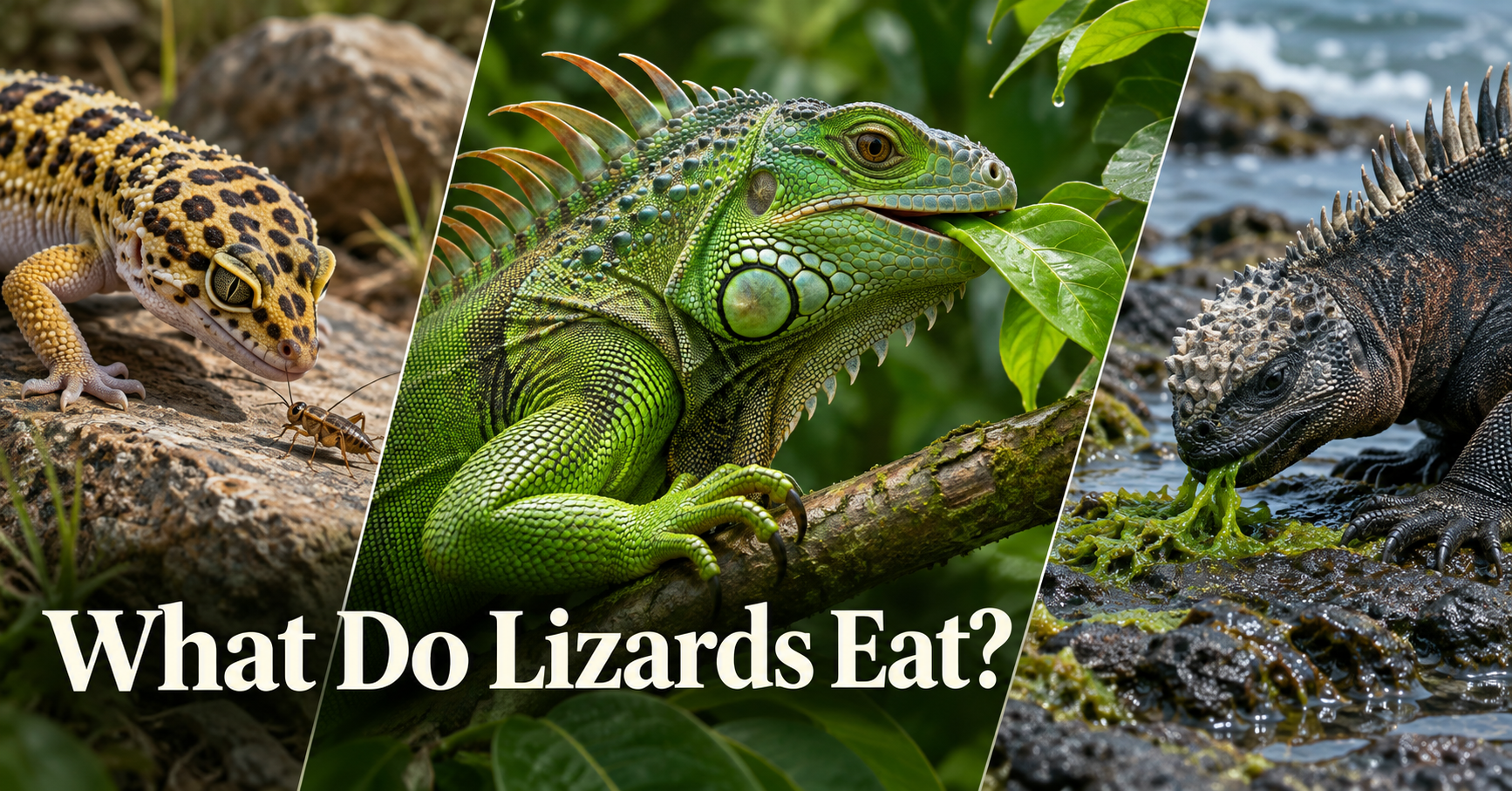
A house gecko snaps up a moth. A green iguana tears a leaf from a vine. On a Galápagos shore, a marine iguana puts its face against a wet rock and scrapes off algae. So what do lizards eat? Many hunt insects and spiders. Others browse leaves, take fruit and nectar, crush snails, or feed on animals as large as deer. These 80 foods span wild feeding records and species-specific captive diets.
What do lizards eat in the wild and at home?
For a wild visitor, look at the animal, its hunting surface, and what actually enters its mouth. For a pet, identify the species and life stage first. Two lizards sold as geckos can need substantially different meals.
| Lizard | Usual feeding pattern | What a meal can look like |
|---|---|---|
| Western fence lizard | Hunts small invertebrates | A fly or spider taken from a lookout on a fence or log |
| Leopard gecko | Insect eater | Appropriately sized crickets and other suitable feeders in captivity |
| Bearded dragon | Omnivore | Insects and leafy vegetables, with the balance changing during growth |
| Green iguana | Primarily a leaf browser | Tree and vine leaves in the wild, or a varied leafy ration in captivity |
| Raukawa gecko | Hunts invertebrates and takes seasonal plant-related foods | A small insect, ripe fruit, floral nectar, or scale-insect honeydew |
| Northern caiman lizard | Specializes in shelled aquatic prey | A freshwater snail crushed in the jaws |
| Marine iguana | Grazes marine algae | Algal growth cropped from coastal rock |
| Komodo dragon | Carnivore and scavenger | Small prey when young, large vertebrates or carrion as an adult |
80 foods lizards eat, with the species and setting for each
For common garden prey and cultured feeders, start with foods 1–20. Aquatic prey, eggs, and larger animals follow in 21–37. Foods 38–54 cover cactus, algae, wild foliage, fruit, and nectar. Foods 55–80 explain the roles of cultivated greens, produce, and a formulated gecko food in captivity.
1. House crickets
A leopard gecko tracking a house cricket gives a good illustration of what “insectivore” means at mealtime. The gecko follows the cricket’s movement, closes the distance, then takes the whole animal. Its meal includes the gut and organs as well as muscle. A piece of chicken cut to cricket size has a very different composition. Crickets can also serve as one animal component of a bearded dragon’s mixed diet. A green iguana watching the same cricket cross its enclosure has quite different nutritional requirements.
A feeder cricket’s last meals matter. Keepers can feed insects a suitable nutrient-rich diet before offering them, a practice called gut loading. This changes what the lizard swallows along with the cricket. Dusting puts a supplement on the outside. The two practices address different parts of feeding, and the amounts depend on the species and the rest of the diet. A box of crickets that has sat unfed for days deserves attention before it goes near the enclosure.
Watch at least the beginning and end of a feeding. A cricket that darts behind a rock counts as food offered, but the gecko may never catch it. Remove leftovers and note roughly how many were actually eaten. That simple distinction makes a feeding record much easier to interpret.
2. Grasshoppers
In open grass or low scrub, a grasshopper can disappear from view in a single jump. For a lizard on a perch, the jump briefly makes an otherwise well-camouflaged insect conspicuous. The moment it lands is an opportunity for a short pursuit. Grasshoppers appear even in the diets of juvenile Komodo dragons. An animal that may eventually feed on deer begins life with a much smaller set of prey within reach.
A grasshopper nymph resembles a miniature adult, usually with wings that have yet to develop fully. A small lizard therefore shares grassland with several possible sizes of the same general food. The abundance of adult grasshoppers says little about whether a hatchling can use them. Vegetation height also matters. An insect among grass stems may be available to a hunter moving through the stems yet hidden from one watching from a distant rock.
Captive-bred feeder locusts are grasshoppers too. In places where they are legally sold, a keeper can select an appropriate size and account for them in the insect portion of a species-specific diet. Garden grasshoppers have an unknown feeding history, especially around crops or treated lawns. Seeing wild lizards catch them is a reason to preserve an insect-rich habitat, rather than a reason to collect a jarful for a pet.
3. Harvester ants
A trail of harvester ants delivers a succession of small meals past one spot. Texas horned lizards make particularly extensive use of these ants. A lizard can station itself beside moving workers and take them individually with its tongue. To someone expecting a reptile to chase one substantial insect, the striking part is how little distance the lizard needs to cover between captures.
Several distinctions get lost when this diet is summarized as “bugs.” Harvester ants are a particular kind of prey, the active workers are accessible above ground, and the colony can send out many workers from the same entrance. The food supply therefore depends partly on an intact colony. A patch of land can still look like suitable habitat after the ants have disappeared. The presence of other insects or a different species of ant does not establish that the same food supply remains.
Horned lizards also differ among species in how strongly they depend on ants. Identifying the reptile and its local prey is more informative than counting every ant on a property. For someone who finds one in a yard, the practical response is to leave it free to forage. Trying to maintain a wild specialist on pet-store crickets overlooks the relationship that made the yard useful to it in the first place.
4. Termites
A termite colony concentrates numerous small, soft-bodied insects in a tunnel system. Only a fraction may be accessible to a lizard at any given moment. When workers are exposed at the edge of damaged wood or winged reproductives emerge, access changes abruptly. A western fence lizard can include termites among its prey even though much of a colony spends its life out of sight.
This is a useful example of the difference between an animal’s diet over a year and the contents of a single meal. A lizard that has recently encountered a concentration of termites may have eaten several of them in quick succession. That observation shows the value of a particular opportunity. It takes observations from other days, seasons, and sites to establish whether termites usually dominate that lizard’s food. A hunter might otherwise spend much of its time watching for beetles and flies.
Visitors sometimes assume a lizard on a wooden fence is eating the wood itself. Watching the space immediately in front of its snout gives a better clue. It may be taking an insect small enough to be invisible at a distance. Where wood has received a pesticide treatment, collecting insects from it for an animal in captivity introduces an unnecessary and difficult-to-assess exposure.
5. Leafhoppers
A leafhopper rests against a leaf or stem, often with its wings folded close around its body. It obtains food by piercing plant tissue. A western fence lizard that takes the leafhopper gets an animal meal from a plant surface. Someone seeing only the lizard’s quick strike at greenery could easily describe the event as leaf eating. A closer look at what disappeared would give a different answer.
Small jumping prey link the lizard’s feeding opportunities to the structure of vegetation. A bare fence post offers a lookout. A nearby stem bearing insects offers a target. The space between them determines whether the hunter can approach easily and whether it can keep the insect in sight after a jump. A garden can have plenty of insects overall while offering comparatively few encounters along a particular lizard’s usual route.
Leafhoppers also illustrate a limitation of household pest control by wildlife. An individual lizard can intercept some of the insects it encounters, but it hunts for its own meals and may switch to another prey type as soon as one passes. Its presence cannot predict the fate of a leafhopper outbreak. For an observer, the interesting evidence is the repeated trip between perch and foliage, especially when the lizard returns to the same lookout after a strike.
6. Aphids
Aphids are small sap-feeding insects that often gather around tender shoots. They have been recorded among the prey of western fence lizards. Because an individual aphid is tiny, a patch of occupied stems presents a very different feeding opportunity from a single large cricket. The lizard’s size, its distance from the stem, and the number of insects within reach all affect the value of that patch.
Aphids can also attract other animals. Ants may visit them for honeydew, and various insect predators visit to eat the aphids themselves. A lizard watching an infested plant thus has more than one potential target. Finding the reptile next to the colony is weaker evidence than watching it take an insect. Nor does a sticky leaf alone show that the lizard was licking a sugary secretion. Some geckos really do use honeydew, but that is a separate feeding behavior with its own evidence.
For a gardener, the most useful conclusion is modest. Small insects that are easy to overlook contribute to the menu of some local reptiles. Keeping part of a garden structurally varied gives those reptiles places to watch and hide. Bringing aphid-covered cuttings indoors for a pet provides much less control over the insect’s identity, chemical exposure, and actual contribution to a balanced meal.
7. Dubia roaches
Dubia roaches are captive-bred feeder insects used for a range of insect-eating lizards. The difference between a young nymph and a mature roach is immediately relevant to a keeper. Buying the right species of insect does little good if the individual insects are too broad for the lizard to handle comfortably. Sorting a batch by size makes it easier to select prey for a particular animal.
Roaches often slip under cover. In a complex enclosure, placing several on the floor can make a feeding look successful simply because the insects disappear. A suitable feeding dish or a supervised presentation can make intake easier to observe. The goal is to see the animal seize and swallow prey while still allowing it to hunt in a way it recognizes. A lizard accustomed to chasing moving targets may take time to notice an insect that sits motionless.
Treat a feeder colony as part of the animal’s food supply. Its nutrition, cleanliness, and access to suitable moisture influence the condition of the prey it produces. Use insects sold for that purpose where legal. A household cockroach found after pest treatment has a very different history. The ability of a wild gecko to catch a cockroach in a building provides little information about the safety of feeding that particular roach to a pet.
8. Mealworms
A mealworm is the larva of a darkling beetle. The name describes its appearance and use as a feeder, although it belongs to an entirely different group from an earthworm. Its segmented body, small legs, and firm outer covering are visible to anyone looking closely. Leopard geckos can take these larvae as part of an insect diet, and their modest movement makes them relatively easy to offer in a dish.
The convenience of keeping a container of mealworms can quietly determine the composition of a pet’s meals. If that container supplies nearly every feeding, the lizard receives the same prey repeatedly regardless of which other insects would suit it. Mealworms, like many commercial feeders, need to be considered in the context of calcium balance and the animal’s supplementation plan. Simply keeping the dish full tells the owner little about those questions.
It is also worth checking what is actually in the container. Larvae pupate, and pupae eventually become adult beetles. These stages differ in shape, movement, and how readily the lizard recognizes them. A record that says “mealworms offered” can therefore conceal a change in both presentation and intake. Selecting suitable larvae and observing the animal feed gives a clearer picture than counting empty spaces in a dish the following morning.
9. Black soldier fly larvae
Black soldier fly larvae occupy an unusual place among feeder insects because their mineral composition can differ substantially from that of ordinary crickets or mealworms. They offer keepers another option when planning a varied insect diet. Their calcium content is a property of the particular food. It cannot, by itself, settle whether a growing reptile receives an appropriate overall diet or has suitable conditions for using that calcium.
The larvae have no cricket-like legs for jumping, and a pile of them may move mainly by wriggling. A lizard that follows motion can respond differently to larvae spread in a shallow dish and larvae bunched together in a deep cup. Choose a presentation the animal can see and reach. Before increasing a portion because the lizard seems uninterested, check whether it has actually noticed the prey and whether the prey size suits its mouth.
These insects are also associated with composting. That does not make larvae from a waste bin interchangeable with food produced for reptiles. A keeper usually cannot reconstruct what household larvae have eaten or which contaminants entered the bin. Purpose-bred stock gives a clearer starting point. Even then, evaluate the larvae as one ingredient alongside the other insects, supplements, and species-specific husbandry that make up the animal’s care.
10. Silkworms
A silkworm is a caterpillar, traditionally raised on mulberry leaves. For lizards that take caterpillars, captive-reared silkworms can add a relatively soft prey item to a rotation of insects. The soft body changes the handling problem for the lizard. So does the caterpillar’s length. A full-grown larva may be inappropriate for an animal that easily handles a much younger silkworm, even though the food name stays the same.
Unlike a cricket that runs across open ground, a silkworm tends to cling to its support. Presenting it where the lizard can see its movements can matter as much as changing which insect is offered. A branch-feeding hunter may attend to a larva positioned near a familiar perch. A ground-oriented gecko may investigate one in an accessible dish. Observe what the particular animal does before assuming that an untouched larva indicates a loss of appetite.
The diet of the feeder is part of its identity here. Commercial silkworms have a known rearing history. A caterpillar picked from an unidentified ornamental shrub may belong to a different moth, eat plants containing defensive chemicals, or have encountered a spray. Similar shape and softness are inadequate grounds for substitution. The silkworm example is most useful as a way to broaden an appropriate captive insect diet with identifiable prey.
11. Waxworms
Waxworms are the larvae of wax moths. Their association with bee colonies explains the name, while their soft bodies and wriggling movements explain much of their appeal as feeder insects. A gecko that takes one immediately may be responding to the movement, texture, or familiarity of the prey. That enthusiastic strike tells the keeper that the animal wanted the larva at that moment. It says less about how often the animal ought to receive it.
Waxworms are relatively rich in fat and are commonly used as occasional additions to an insect diet. A familiar trap is to replace every uneaten regular feeder with a waxworm. The owner may feel reassured because something was eaten, while the reptile’s actual diet becomes increasingly narrow. Recording what was swallowed, including treats, makes that pattern visible. The food left in the dish is only half of the record.
There is also a useful distinction between encouraging a healthy animal to investigate food and responding to a sustained change in appetite. Repeatedly offering a preferred larva can obscure a developing problem if body condition is declining. Review the enclosure conditions and seek reptile veterinary advice about persistent changes. The value of a waxworm in an otherwise suitable rotation is its particular contribution, rather than its ability to stand in for every missed meal.
12. Hornworms
The bright feeder hornworms sold for reptiles are large caterpillars with a characteristic projection near the rear of the body. The projection gives the animal its common name. The feature a keeper most needs to notice, however, is how rapidly the size of the prey can change. A batch purchased for a small insectivore can grow beyond a suitable size before all the larvae have been used.
A captive-raised hornworm has a known diet. A similar-looking caterpillar on a garden tomato or tobacco plant comes with a different feeding history, including exposure to plant chemicals and possibly pesticides. Use stock raised for reptiles and check the size of each larva at the time of feeding. Selecting by yesterday’s impression of the batch can lead to offering prey the lizard struggles to manage.
The moist body contributes water along with food. This is one reason keepers notice hornworms when comparing the textures of commercial feeders. An occasional moist meal still leaves the animal dependent on a reliable drinking arrangement appropriate to its species. A keeper can get a more useful impression of a lizard’s habits by noting whether it finds the worm, whether it can swallow the prey easily, and how it accesses water between meals. Each observation answers a different husbandry question.
13. Fruit flies
For a very small insect-eating lizard, the usual difficulty with a box of feeder insects is finding enough individuals of a suitable size. Cultured fruit flies offer tiny moving targets. Flightless strains are particularly practical because the keeper can present prey in a contained area and watch what happens. A hatchling still needs a diet chosen for its species. Being small does not automatically make it an insect eater.
Fruit flies also explain why finding a gecko beside overripe fruit can be misleading. One gecko may be licking the fruit, another may be watching flies arrive, and an omnivorous individual might do both. The movements look different up close. A deliberate lick takes material from the surface, whereas a quick strike can pick off an animal that was standing on it. A photograph of a gecko beside a banana rarely resolves the question.
In a food culture, count activity as well as flies. If most have escaped or remain out of sight in the substrate, estimating how much a hatchling ate becomes difficult. Introduce prey where the animal can locate it and monitor its condition over time. A clean culture maintained for feeding is also a more predictable source than flies collected around refuse, where the keeper cannot identify everything the insects have contacted.
14. Houseflies
A fly landing within reach of a western fence lizard may end a long period in which the reptile appeared to be doing nothing. Waiting is part of its hunting strategy. A fence, log, or rock provides an elevated view, and the arrival of an insect makes a short burst of movement worthwhile. A lizard that spends much of an afternoon on one post can therefore be an active participant in the local food web.
The same fly changes its availability several times in a few seconds. In open air it may be difficult for a ground-based hunter to intercept. On a sunlit board it may be conspicuous. Inside a crack it may be unreachable. These differences help explain why a lizard can feed on flies without chasing everything that crosses the air above it. The feeding site is defined as much by landing surfaces as by the abundance of insects.
People occasionally place food scraps outdoors to encourage flies for a resident lizard. This changes which animals gather at the site and makes sanitation more difficult. An established patch of vegetation and cover allows wild lizards to locate prey on their own. If flies are wanted as captive feeders for a suitable insectivore, clean rearing stock gives the keeper a much better understanding of their origin.
15. Adult moths
Watch a house gecko near an outside light after dark and the importance of landing places becomes apparent. A moth circling beyond the wall may never come within reach. Once it settles against the wall, its folded wings and the gecko’s climbing ability put hunter and prey on the same surface. Nocturnal geckos often use opportunities like this, and moths occur in the diets of wild New Zealand geckos as well.
Wings make a perched moth look larger than the body the lizard actually has to handle. That changes how a human observer estimates the size of a meal. A wide silhouette on the wall may contain relatively little body tissue, and loose wings occasionally remain after a capture. Conversely, a thick-bodied moth can present a substantial handling challenge to a small gecko. The word “moth” covers many sizes and species.
A gathering around a lamp can reveal a feeding relationship without establishing that artificial lighting benefits every nocturnal animal. Light changes where insects accumulate and which predators can reach them. If a gecko visits an existing light, it is possible to watch quietly from a distance. Adding lights or collecting unidentified moths for an enclosure introduces new variables and contributes little to understanding what that individual ordinarily eats.
16. Bean beetles
Bean beetles provide an example of small adult beetles used as cultured prey. The larvae develop inside stored legumes, and adults emerge small enough for certain insect-eating reptiles to handle. The keeper offers the insect itself. Beans left behind in a culture are part of the rearing system and are unsuitable substitutes for an insectivore’s meal. The distinction is easy to overlook when a container holds both.
An adult beetle poses a different handling task from a soft larva. Its firm wing covers, compact body, and ability to move across a surface influence how readily a lizard recognizes and swallows it. For a small animal already accustomed to hunting fruit flies, a few appropriately sized beetles can introduce another prey shape. The useful observation is whether the reptile actually captures them. A cup emptied into a planted enclosure gives surprisingly little information about intake.
Keep the culture separate from pantry legumes and prevent escape. A food animal can become a stored-product pest if allowed to reproduce in the wrong place. For the same reason, distinguish a known feeder culture from unidentified beetles in household food. A store of infested beans provides no reliable account of prior pest treatment. The practical value of bean beetles lies in controlled access to a particular small insect with a known origin.
17. Spiders
Spiders appear in the diets of western fence lizards and many other small insect hunters. Although spiders have eight legs and belong to the arachnids, a lizard looking for suitable prey need not observe the boundary implied by the word “insectivore.” It can seize a spider moving across a log during the same outing in which it catches a fly. The term describes a general feeding pattern, not a taxonomic inspection of every bite.
A spider’s location can matter more than the number of spiders present. One moving through leaf litter is available to a hunter searching close to the ground. Another suspended in a web above a gap may be beyond that animal’s reach. A third tucked inside a retreat can remain invisible even when the lizard passes beside it. The overlap between the two animals’ daily routes helps determine whether they meet.
The direction of predation also depends on size. A large spider and a tiny hatchling present a very different encounter from a mature fence lizard facing a small spider. There is little reason to test an unfamiliar pairing in captivity. For household observations, a better question is where each animal was moving immediately before contact. That can explain an apparently unexpected meal without turning all spiders into recommended reptile food.
18. Woodlice
Woodlice are terrestrial crustaceans. Their flattened, segmented bodies are familiar beneath damp wood, stones, and fallen leaves. Small lizards that search these sheltered places can encounter them even when few insects are moving in the open. Their presence expands the meaning of “small invertebrates” beyond beetles and flies. A patch of damp litter has its own prey community, quite different from the one visible on a sunny fence rail.
Because woodlice help break down dead plant material, they also show how a lizard can gain energy from fallen leaves without eating the leaves. The intermediate animal consumes decaying material, and the reptile takes the animal. This is a different route through the food web from the direct browsing of a green iguana. Watching a skink push its nose through litter gives no reason to presume that the leaves themselves are its target.
Cultured woodlice are sometimes present in planted reptile enclosures as a cleanup crew. Some may become prey where the resident lizard is small enough to use them. A resident colony, however, makes intake hard to measure and its members may spend most of their time under cover. Treat such captures as an additional opportunity when assessing the animal’s routine diet, and leave wild populations beneath garden logs undisturbed.
19. Springtails
Springtails are minute soil-dwelling arthropods that thrive in many moist environments. Some leap when disturbed, creating a moving target that a very small insect-eating reptile can notice. Their size is the main reason they appear in discussions of tiny feeders. To an adult lizard accustomed to substantial crickets, a scattering of springtails may represent almost no usable meal even where the enclosure supports a large population.
Springtails also occur in planted enclosures because they consume fungi and material associated with decomposition. A keeper may introduce them to help maintain the substrate and later see a small lizard investigating the surface. Both roles can be real. What is difficult to infer is the amount eaten. Many individuals can occupy spaces in the substrate that the lizard cannot reach, and a prey animal visible against a white culture container can be nearly invisible on living soil.
Where cultured springtails form part of a suitable small lizard’s food supply, pay attention to the location of feeding as well as the culture’s apparent productivity. A small area that permits observation can reveal whether the animal notices and takes the prey. Continuing access to appropriately sized, nutritionally managed feeders remains important. A thriving population of soil organisms describes the enclosure far better than it describes the nutritional status of its resident.
20. Earthworms
An earthworm is an annelid, a segmented animal with a soft body and no legs. Ground-foraging lizards such as some blue-tongued skinks can include earthworms in a mixed diet. The prey occupies the moist zone below litter or near the soil surface. An animal that actively investigates cover has access to food that an otherwise similar-sized hunter on a high branch will seldom encounter.
Moisture changes the opportunity to feed. Soil conditions influence how close worms are to the surface, and a patch that looked empty in dry weather may offer accessible prey after rain. That is a statement about access. It does not establish that every skink changes to a worm-based diet whenever it rains. The lizard still needs a suitable body temperature for activity and must find prey of a manageable size during the time it can forage.
The source of worms matters for captive feeding. A worm from a treated lawn or a bait container with unfamiliar additives has a poorly understood history. Use a source intended for animal feeding and select a size suited to the species. There is no general reason to put earthworms in a green iguana’s salad or to assume that a leopard gecko accustomed to crickets will use them in the same way as a ground-searching skink.
21. Slugs
Slugs are shell-less or reduced-shell mollusks found in damp crevices, vegetation, and litter. Blue-tongued skinks are among the lizards that can take them. A slug offers soft tissue without the substantial external shell of a snail, changing the work involved in handling it. Its slow movement also creates a very different encounter from a skink chasing a fast insect across open ground.
Gardeners sometimes welcome a visiting skink because they have seen it eat a slug. The observation establishes a local predator-prey relationship. It takes much more information to predict whether the animal will keep damage to garden plants below a particular level. The skink may spend part of the day sheltering, choose other prey, or move outside the garden. Suitable cover and freedom to move matter to the reptile independently of the service people hope it provides.
Slug baits introduce a practical concern in exactly the places where these animals meet. Avoid collecting garden slugs for a pet, especially where the history of bait and pesticide use is unknown. If a captive reptile needs a particular mollusk as part of a planned diet, seek species-specific advice and a suitable feeder source. A wild skink’s ability to find its own meals is a poor guide to the safety of an individual slug supplied by hand.
22. Apple snails
The northern caiman lizard has a broad head and strong jaws well suited to processing freshwater snails. An apple snail offers a substantial body inside a hard, rounded shell. Reaching the edible tissue is a problem that a typical fly-catching gecko rarely faces. The caiman lizard can position and crush shelled prey and manipulate the fragments as it eats. Its teeth and jaws make sense when viewed alongside the meal.
A river margin or flooded area supplies more than water for swimming. It gives this semiaquatic reptile access to mollusks moving on submerged surfaces. A snail that would be inaccessible to a land-bound lizard can be within reach of one that forages in water. The shells visible at the edge may indicate suitable habitat, although empty shells alone do not establish when or by which predator their occupants were eaten.
The name “caiman lizard” sometimes confuses readers because a caiman is a crocodilian. The snail-crushing animal here belongs to the lizard genus Dracaena. Its specialization does not transfer to all other reptiles living beside tropical rivers. Nor does it make an aquarium snail of unknown origin an appropriate feeder. For understanding the natural diet, the important combination is a freshwater mollusk, a semiaquatic hunter, and jaws capable of opening the protective covering.
23. Freshwater clams
Clams bring a different kind of shell to a caiman lizard’s menu. The two valves close around the soft body, whereas a freshwater snail usually has a single coiled shell. Both are mollusks, but their shapes present different surfaces to a predator’s jaws. Caiman lizards can take clams among other aquatic invertebrates. This is a specialist example of shellfish consumption within a much broader group of reptiles.
The location of the prey changes its accessibility. A clam buried deeply in sediment may be present in a stretch of water without being available to a foraging animal. An exposed or shallowly placed individual offers a different opportunity. A list of aquatic species living in the same wetland therefore describes possible encounters only loosely. Feeding records are more informative than habitat overlap when deciding whether to include a prey item in a lizard’s diet.
For household care, the word “clam” can suggest a tin from the pantry or a prepared seafood dish. Those products differ in salt, seasoning, handling, and presentation from a mollusk encountered in fresh water. Even plain clam tissue is only part of what a shell-processing reptile would encounter. The natural history example helps explain how jaws and habitat shape food choice. It offers little guidance for planning meals for an unrelated terrestrial pet.
24. Crayfish
Crayfish, sometimes called crawfish, are freshwater crustaceans with jointed legs, claws, and an external skeleton. They occur in the diet of caiman lizards. A crayfish can move away, reverse rapidly, or take cover. That changes the encounter from the relatively stationary task of opening a clam to the combined tasks of capture and handling. Broadly labeling both meals “shellfish” conceals a meaningful behavioral difference.
A shoreline is especially interesting where underwater hiding places meet basking sites. A semiaquatic lizard can use both nearby resources over the course of a day. Time spent motionless above water does not mean all its food comes from the surface, and a brief sighting of a dive gives little information about which prey it found. Watching where it resurfaces and what it is handling may reveal more than the plunge itself.
In a captive setting, the ability to overpower natural prey is a poor reason to release clawed animals into any reptile enclosure. Prey size, enclosure design, the lizard’s species, and the risk of injury all affect appropriate presentation. For most owners this relationship is chiefly an ecological example. A caiman lizard uses a freshwater food supply that a desert herbivore or a wall-dwelling insect hunter has neither the opportunity nor the equipment to exploit regularly.
25. Freshwater crabs
A Nile monitor can feed on crabs along waterways. A crab’s sideways movement, pincers, and broad shell give it a very different outline from a fish. Both foods can occur along the same bank, which helps explain why a monitor that uses the boundary between land and water has access to an unusually broad range of prey. Moving from one patch of shoreline to another can change the menu without a change in climate or season.
The short distance between a crab and its burrow or other refuge can decide an encounter. Counting crabs along a bank without considering the protection available to them would overstate the number of easy meals. Size also matters on both sides. A crab manageable for a large monitor may be too well defended for a young one, while a tiny individual can occupy a gap inaccessible to the larger hunter.
A lizard carrying a crab on land has not necessarily caught it in deep water. Crabs can be encountered at the margin, and a predator can carry prey after capture. Distinguishing where a meal was taken from where it was swallowed makes field observations more informative. It also prevents a familiar mistake in descriptions of reptile diets, where almost any food seen beside water gets described as a fish.
26. Small fish
Fish occur in the diet of Nile monitors and can also be taken by caiman lizards. A swimming animal, however, is not necessarily a fish specialist. It may be crossing a channel, escaping danger, or searching for shelled invertebrates. Even a monitor seen eating a fish has demonstrated only that it obtained a fish. A direct view of capture is needed to distinguish a live catch from a dead fish found along the bank.
Water depth and cover change what “available fish” means. A fish with room to turn and accelerate poses a different challenge from one confined in a shallow pool. Vegetation can conceal a fish while also bringing a searching predator close to it. These conditions explain why the same lizard might find fish profitable in one small part of a wetland and spend time searching for other foods nearby.
Aquarium fish are sometimes proposed as entertainment or as a quick answer to what a pet lizard might eat. The natural record gives limited support for that idea. Prey identity, nutrition, disease risks, and the resident reptile’s actual feeding niche all matter. A fish meal for a specialist under professional care has a different rationale from adding a fish to the water dish of a bearded dragon or gecko.
27. Frogs
Frogs are recorded prey of Nile monitors. The two animals meet where water, vegetation, and exposed banks adjoin. A frog may sit within reach one moment and vanish into the water the next. A monitor that searches both the bank and the shallows can pursue feeding opportunities on either side of that boundary. That access helps explain the amphibian component of its diet without requiring a preference for frogs over other prey.
A frog’s calls tell a person that frogs are present, but a chorus alone gives little information about their importance as reptile food. The calling animals may be concealed, active at a different time from the lizard, or large enough to be difficult prey. A seasonal gathering can create a burst of potential encounters while leaving the monitor dependent on other foods during much of the year.
Readers sometimes encounter this relationship in reverse. A sufficiently large frog can prey on a small lizard. The names of the two groups do not determine which individual has the size advantage in a particular meeting. Leave such interactions to wildlife. Collecting an amphibian for a captive reptile creates questions about species identity, defensive skin secretions, pathogens, and wildlife protection that do not arise when watching an unmanipulated encounter from a distance.
28. Small turtles
Small turtles appear among the recorded vertebrate prey of the Nile monitor. Here the size qualifier matters as much as the food name. A hatchling with a small body presents a very different opportunity from a large adult protected by a substantial shell. A statement that a monitor can eat turtles describes a relationship with certain individuals under particular conditions. It does not make every turtle sharing a river a plausible meal.
The shore can bring these animals together for reasons other than hunting. Both may bask on exposed surfaces. Turtles may also move between water and nesting habitat, and a young animal heading toward cover can cross a monitor’s foraging route. A person seeing the two reptiles together should distinguish quiet proximity, investigation, and actual predation. Observations of each behavior answer different questions about how the species use the same site.
This food is especially useful for understanding why mixed-species enclosures require expert planning. Sharing a continent, water temperature, or basking preference says little about whether two animals can safely occupy the same restricted space. The vulnerable life stage may have no way to leave. In the wild, cover, access to water, the size of the animals, and the timing of encounters all influence a relationship that a short list of foods barely conveys.
29. Small geckos
Young Komodo dragons include small geckos among their possible prey. A gecko is itself a lizard and may have been hunting insects only moments before becoming food for another reptile. A simple chain can therefore run from a plant-eating insect through a gecko to a young monitor. Which animal occupies the predator position depends on the particular relationship being described, not on whether its name includes “lizard.”
Juvenile Komodo dragons spend time in trees, where the available prey differs from the large mammals used by adults on the ground. A small gecko on bark is within a young monitor’s size range and shares part of its climbing environment. The transition as the monitor grows includes more than increased appetite. It changes the surfaces the hunter uses, the size of prey it can handle, and the animals it is likely to encounter.
In a garden, the disappearance of a gecko after another lizard arrives does not prove that predation occurred. Both animals may simply retreat from observation. A witnessed capture is stronger evidence than a change in the number visible on a wall. For keepers, the possibility of one lizard eating another is a good reason to evaluate housing by species and individual size, even when both ordinarily receive the same commercial insects.
30. Gambel’s quail eggs
At Tonto National Monument in Arizona, a Gila monster has been observed eating Gambel’s quail eggs. The specificity of that record is useful. It identifies the predator, the bird, and the life stage that supplied the meal. Saying the lizard “eats quail” could give a reader the quite different impression of a slow-moving reptile overtaking an adult bird in the open desert.
A ground nest concentrates several relatively immobile food items in one spot. The difficult part for the predator is finding the nest during the short interval when it contains eggs. Gila monsters investigate their surroundings using chemical cues collected by the tongue. For a searcher with these abilities, concealed food can be worth seeking even when most of the desert surface appears empty. Discovering one nest also changes how many meals are accessible without much additional travel.
Eggs contribute animal tissue and stored nutrients made available for a developing bird. Their presence in a Gila monster’s diet does not turn a supermarket egg into an all-purpose reptile ration. A leopard gecko’s ordinary prey, a browsing iguana’s vegetation, and a nest predator’s occasional find have very different roles. Leave wild nests undisturbed, whether the goal is wildlife photography, bird protection, or an opportunity to watch this unusual lizard feed.
31. Nile crocodile eggs
A Nile crocodile is a formidable adult predator, yet its eggs can be food for a Nile monitor. This reversal is a reminder that a food web needs life stages as well as species names. The same waterway can support adult crocodiles dangerous to monitors and buried eggs vulnerable to them. There is no contradiction once the animal’s size, mobility, and defenses at each stage are considered.
For the monitor, finding a nest is different from chasing an individual prey animal. The food is spatially concentrated, concealed, and available for a limited developmental period. Access can depend on the position of the nest and the activity of the attending crocodile. A successful visit can affect several eggs at one location, while a neighboring stretch of shoreline with no nest offers none of this particular food.
Reports of nest predation sometimes prompt people to frame the monitor as a problem animal. Eating eggs is part of its natural role in ecosystems where the species coexist. Conservation questions about a particular nesting population require evidence about the site, season, and other causes of loss. The fact that a monitor is capable of raiding nests cannot identify the cause of a specific failed clutch, much less establish that wildlife should be fed, moved, or disturbed.
32. Dove nestlings
Gila monsters sometimes feed on nestling doves and other young birds. A nestling lacks the escape options of an adult dove. Its location may be concealed, but once found, a nest offers a predator access to prey that cannot simply fly away. That combination helps explain why a heavy-bodied desert lizard can include birds in its diet without being a hunter that regularly pursues adult birds in flight.
There is a useful distinction between a nestling and a fledgling. A nestling still depends heavily on the nest, whereas a fledgling may be outside it while its parents continue to provide care. Observing a young bird on the ground establishes neither abandonment nor the presence of a reptile predator. If the interest is natural history, distance limits disturbance and gives a better chance of seeing what the animals actually do when their movements are unconstrained.
Bird prey also illustrates how broad headings can hide information about seasonality. Nestlings are available only while local birds are reproducing and only at nests within reach. A lizard recorded eating one is taking advantage of a brief stage. For much of the surrounding year that food may be entirely absent, despite the continued presence of adult doves. The names of resident species alone cannot provide a year-round menu.
33. Young desert cottontails
A young desert cottontail is a documented meal for a Gila monster in Arizona. The age of the rabbit explains much of what might otherwise seem surprising. An adult cottontail’s speed in open ground bears little resemblance to the situation of a small young animal in a nest. A searching lizard can find the latter without winning a chase against the former.
The encounter belongs to a desert food web that is easy to miss during a daytime walk. Mammal nests, sheltered resting places, and the physical openings through which a hunter can investigate them concentrate activity in small spaces. To a person looking across apparently bare ground, the area may look poor in food. A Gila monster using chemical information can encounter a patchwork of opportunities that is scarcely visible from above.
Rabbits are sometimes discussed simply as a large source of meat. That description leaves out where the prey came from and what part of its life cycle made it accessible. Whole juvenile prey also differs from a cut of rabbit meat sold for human meals. Neither the observation nor the meat’s availability is a basis for offering rabbit to an unrelated pet lizard. The important biological detail is a particular nest predator encountering a vulnerable young mammal.
34. Young kangaroo rats
Kangaroo rats are desert rodents, and their young can be taken by Gila monsters. An adult kangaroo rat moving quickly across open sand looks like an unlikely target for a comparatively slow hunter. Its young occupy a different situation. Searching for concealed young allows a predator to use scent and persistence in places where running speed would provide relatively little advantage.
The burrow itself affects how the animals meet. Narrow passages, chambers, and the depth of a nest can put young rodents beyond a particular predator’s reach. An opening in the ground is evidence of shelter, rather than evidence that a nest has been successfully raided. Equally, a Gila monster approaching a burrow may be investigating or seeking shelter. Watching the full sequence matters before identifying a meal from a brief encounter.
For the food web, this relationship connects a rodent that gathers plant foods to a lizard that obtains its energy from animals. No seeds need appear in the reptile’s mouth for seed production to influence the food supply farther up the chain. Changes in plant production can affect rodents, and changes in the number and timing of rodent litters can change a predator’s opportunities. The dependencies are indirect and need not produce identical effects in every desert season.
35. Timor deer
Timor deer, also called rusa deer, are major large prey for adult Komodo dragons in parts of their Indonesian range. A deer brings a very different scale to the question of what a lizard eats. Reaching this type of prey requires a combination of adult body size, access to suitable habitat, and a supply of deer. It tells us little about what a young dragon in a tree can feed on.
A deer can supply food through more than one route. A dragon may attack living prey or locate a carcass after the animal has died. Seeing dragons at a carcass establishes that they are feeding there. It takes additional evidence to identify the hunter that made the kill or the original cause of death. Several dragons may visit the same remains, so counting feeding animals also gives a misleading estimate of the number of deer involved.
The importance of a large carcass is partly that it concentrates food in one place for a time. Animals of different sizes may reach it at different times and face different risks around one another. A small, quickly swallowed insect leaves little comparable opportunity for another predator. This makes deer a particularly clear example of how prey size changes feeding behavior as well as the amount of food available.
36. Wild pigs
Wild pigs are among the large mammals consumed by Komodo dragons. The label covers animals of markedly different sizes. A young pig and a mature boar present very different risks and handling problems, even though both would appear under the same food name in a diet summary. A dragon’s own size and whether the pig is alive or already dead further change the encounter.
Pig remains can attract a monitor capable of locating animal odors in its surroundings. A dragon repeatedly flicking its tongue is sampling chemical information, one component of its search for food. Following such information can lead to an existing carcass as well as to living animals. It would therefore be an error to describe every meal of pig flesh as evidence of a long chase or a fresh kill.
This example also helps interpret lists of large prey in popular wildlife accounts. Deer, pigs, and buffalo may all occur in an adult dragon’s diet, but listing them side by side supplies no frequency, ranking, or serving size. The local abundance of each mammal and the circumstances of a particular observation matter. For a reader trying to understand ordinary backyard lizards, pigs belong at the specialized large-predator end of the comparison, far removed from the daily scale of a fence lizard’s hunting.
37. Water buffalo
Water buffalo appear in accounts of adult Komodo dragon feeding. Their enormous size makes this example memorable, but the size difference also calls for careful interpretation. A monitor can feed on part of a carcass many times its own weight. It does not need to overpower or swallow the entire animal for buffalo tissue to form part of its diet. The event observed may be scavenging, predation, or feeding after another dragon made the initial attack.
The difference is especially important when a photograph shows several dragons beside one buffalo. That scene demonstrates access to a shared food source. It cannot establish how much each individual ate, whether all the animals cooperated, or how often any one of them encounters buffalo. Large and conspicuous carcasses are also easier for people to notice than the small meals taken by young dragons away from open ground.
A field observer could record the state of the carcass, the number and size of visiting dragons, and whether the original attack was witnessed. These details turn a dramatic sighting into a more informative description of feeding. For understanding the broader lizard diet, the informative feature is the capacity of a very large monitor to use substantial mammal remains. Having scales or a long tail alone predicts nothing comparable in a small pet reptile.
38. Prickly pear cactus pads
On arid Galápagos islands, prickly pear cacti link land iguanas to a plant well adapted to scarce rainfall. The flat green pad is a stem, even though its broad surface looks like a leaf. Its living tissue contains both food and moisture. A land iguana encountering a fallen pad can obtain material that a tall, upright cactus otherwise carries beyond its normal feeding height.
Ground-level access is particularly important when explaining why a lizard waits beneath a productive plant. The tree-like cactus may hold plenty of tissue above the animal, yet a fallen pad changes the supply at ground level immediately. The same cactus can also support birds seeking other resources. Describing it as food for one reptile captures only part of its role in an island community with few large plants.
People familiar with edible cactus from a grocery store may recognize the general structure. Cultivated pads prepared for human use, however, come from particular plants and can contain spines or tiny barbed bristles before preparation. An island reptile’s use of wild cactus is best understood as a relationship with local vegetation. It does not show that a house gecko needs cactus, or that an unidentified ornamental succulent is safe to add to a herbivore’s bowl.
39. Creosote bush flowers
The desert iguana of the southwestern United States and Mexico eats flowers and buds of the creosote bush. Its yellow blossoms give a concrete answer to a surprisingly tricky question about desert diets. A landscape that looks dry and sparsely vegetated can produce a temporary flush of accessible plant food. The presence of a shrub throughout the year does not mean its flowers are available throughout the year.
Creosote can serve more than one purpose to the same lizard. The shrub provides concealment, and the ground beneath it can offer a place to burrow. A reptile seen under the foliage might therefore be sheltering, moving toward a burrow, or feeding. A bite that removes part of a flower is better evidence of diet than a photograph in which the lizard and the flowering shrub simply share the frame.
Flower feeding also differs from nectar drinking. The iguana can take tissue from the blossom itself, while some geckos visit flowers to lap liquid. Both animals might be called flower visitors, yet the resource they obtain and their influence on the plant can differ. For this desert relationship, noticing exactly which part disappears gives a more informative description than assigning the reptile a general fondness for bright colors or sweet food.
40. Red turf algae of the genus Gelidium
Galápagos marine iguanas crop marine algae growing on coastal rocks. Red algae of the genus Gelidium are among their documented foods. In the water, a low growth of algae can look like a coating on stone. For a reptile with jaws capable of scraping it away, that narrow layer is a feeding surface. It supports a grazing strategy quite unlike the fish hunting people often imagine when they hear of a marine reptile.
The tide changes access on a schedule that the plants themselves do not control. An algal patch can be exposed, submerged in shallow water, or covered by enough water to require a dive. Feeding opportunities depend on the height of the patch, sea conditions, and the size and abilities of the iguana. Two animals on the same shore can therefore use different portions of the same algal habitat.
A rock occupied by a basking iguana may play an entirely different role from a nearby rock used for grazing. After immersion, the animal can regain heat on land. Its day alternates between the physical conditions needed to obtain food and those that support continued activity. This is why the ecological meaning of Gelidium extends beyond the name of a red alga. Where it grows matters as much as what it contains.
41. Sea lettuce of the genus Ulva
Sea lettuce is a green marine alga eaten by Galápagos marine iguanas. The common name refers to the appearance of its thin green blades. It has no close nutritional or ecological equivalence to the lettuce in a refrigerator. Sea lettuce grows attached to a marine substrate in a changing tidal environment. A grazing iguana reaches it by moving across coastal rock or entering the water.
At some sites the relative accessibility of green and red algae changes with the tides. If a favored patch remains under water, another patch may become the better available feeding site. Seeing an iguana eat Ulva on one occasion thus does not settle whether it prefers that alga under every condition. Preference is easiest to evaluate when the animal can reach more than one food at comparable cost, an assumption that a rocky shore frequently violates.
The same reasoning helps explain why accounts from different islands can emphasize different algae. Shore shape, wave exposure, algal growth, and sampling time all affect which meal a visitor is likely to see. The reliable conclusion is the marine iguana’s use of attached algae, including sea lettuce where suitable growth occurs. Dried sheets sold for human consumption represent an entirely different setting and have no general place in feeding terrestrial lizards.
42. Hog plum leaves
The tree called hog plum, Spondias mombin, supplies leaves to wild green iguanas in Panama. The plant name tends to draw attention to its fruit. In the feeding record at issue, however, the relevant food is the leaf. A tree that yields edible fruits for one animal can supply a quite different tissue to another animal sharing its canopy. Recording the plant part prevents a misleading entry in a list of “fruits iguanas eat.”
A green iguana moves through a branching habitat, with reachable shoots and leaves unevenly distributed around possible perches. Some branches support its weight more readily than others. A fruiting tree visible from far away can therefore be useful even when its fruit is unavailable, provided the lizard can reach foliage. This gives leaf browsers access to resources outside the narrower season when a particular tree produces ripe fruit.
The green iguana’s hindgut contains microbes that help break down fibrous plant material. That digestive arrangement helps explain how recurring meals of foliage can sustain a large reptile. It also gives context to captive recommendations centered on leafy greens. Hog plum leaves document one local wild food. They are not a required ingredient that a keeper needs to import, and the common name should never be the sole basis for identifying a tree for feeding.
43. Gumbo-limbo leaves
Gumbo-limbo is a tropical tree known scientifically as Bursera simaruba. Its peeling bark is one of its most conspicuous identification features, but the part recorded in the diet of green iguanas in Panama is its foliage. A lizard climbing the trunk may be using the bark for traction on its way to the leaves. It would be easy to mistake the most visible part of the feeding site for the food itself.
Large browsing reptiles face choices that are less obvious than a predator’s choice between two moving prey animals. A branch may offer shade and security, while a neighboring tree offers the foliage the animal chooses to eat. Moving between the two costs effort and can expose the animal. A brief feeding visit followed by a return to a familiar resting place can therefore be more informative than a long observation of basking in the first tree.
Gumbo-limbo is one example among many trees and vines that can contribute to a local green iguana diet. Its occurrence in one population establishes a natural feeding relationship without showing that it is essential elsewhere. A keeper trying to reproduce the role of wild foliage should think first about species-appropriate leafy nutrition, fiber, and variety. Trying to reproduce a tropical tree list from one study site answers a different question.
44. Trumpet tree leaves
Cecropia peltata, often called a trumpet tree, has large, conspicuously lobed leaves. Green iguanas in Panama have consumed this foliage. The broad outline makes it an especially good example for understanding the scale of a browser’s meal. “A leaf” is a botanical unit, but one leaf can be much larger than a single bite. Portion counts based on leaf numbers have limited meaning across different trees and vegetables.
Large leaves are also useful surfaces for other organisms. An insect-hunting lizard on the same tree might strike at a fly or another arthropod walking across a leaf. A green iguana may remove the leaf tissue itself. The feeding events occur centimeters apart in a similar physical setting but draw energy from different levels of the food web. Close attention to the mouth and the material removed helps distinguish them.
Tree identity provides one level of precision and plant-part identity provides another. Neither one alone establishes the amount eaten through a season. A few bites witnessed on an accessible lower branch can confirm feeding without revealing what happens higher in the canopy. That is why a well-described example of trumpet tree foliage belongs in an account of actual foods, while claims that this tree dominates the diet across the green iguana’s range would go beyond the observation.
45. Bitter melon leaves
Bitter melon is the vine Momordica charantia. People who recognize it from a produce market are generally thinking of its ridged fruit. Wild green iguanas in Panama have eaten the leaves. This distinction is important whenever human and animal uses of a plant are described together. Knowing which part people cook says little about which part a reptile selects while moving along a vine-covered branch.
A climbing plant can distribute foliage through the canopy of a much larger tree. A viewer on the ground may see an iguana feeding high in that tree and naturally assign the meal to the tree species. If the leaves actually belong to a vine, the feeding record changes. Following the leaf stalk back to its stem, where possible without disturbing the animal, helps establish what supplied the bite.
This example also shows why “vegetables” is an imprecise description of a wild iguana diet. The animal is browsing available vine leaves. It has no reason to treat plants according to the culinary categories people use for shopping. Conversely, a wild record for a particular vine leaf supplies no general instructions for feeding market bitter melon, concentrated extracts, or another plant with a similar name. The strength of the example lies in its precise location, plant identity, and tissue.
46. Balloon vine leaves
Green iguanas in Panama have eaten the leaves of large balloon vine, Cardiospermum grandiflorum. Its common name comes from the distinctive inflated fruit capsules. Those capsules make the plant memorable, but the feeding record concerns foliage. A photograph optimized for identifying a plant may foreground a part that never appears in the account of what the observed lizard ate.
Vines complicate the idea that a tree-dwelling iguana feeds from a single tree. Several plants can share one support, and their leaves may lie within a short movement of the same perch. The animal can change food species without descending to the ground or moving across an obvious gap in the canopy. From far below, a sequence of meals on different plants might look like continuous feeding in one crown.
One practical lesson for observations is to keep distinct notes for the supporting plant and the food plant. If identification is uncertain, a description such as “leaves of a vine growing through the tree” conveys more accurate information than a confident but unverified tree name. For captive animals, the existence of this dietary record does not justify gathering an unfamiliar vine. Green iguanas can receive suitable cultivated leafy foods with a known identity and growing history, which are easier to evaluate as parts of a balanced diet.
47. Coprosma berries
Coprosma shrubs produce fleshy fruits eaten by some New Zealand geckos and skinks. A jewelled gecko picking a berry from a shrub is a good counterexample to the assumption that all geckos live entirely on insects. Fruit becomes available during particular periods, while the same branches can also carry arthropod prey. A single shrub can support feeding through more than one route.
The size and position of a berry help decide who can use it. A small fruit among tightly branching stems may be within easy reach of a climbing reptile. Larger fruit that is already soft might instead be used a little at a time. Whether a seed is swallowed, dropped, or left attached to the fruit changes the potential benefit to the plant. Seed dispersal requires more than a visit by an animal with fruit juice on its mouth.
For a garden in New Zealand, a locally suitable Coprosma can provide cover as well as seasonal food. Planting appropriate native vegetation lets wild animals decide when and how to use it. Outside that setting, the biological lesson is the close match between a local shrub and its visitors. It does not establish that every ornamental berry in another country belongs in a gecko’s diet, or that an insect-eating leopard gecko needs fruit.
48. Kawakawa fruit
Kawakawa, Piper excelsum, produces fleshy fruit used by native New Zealand lizards. The plant is often recognized by its leaves, yet the documented diet item here is the fruit. Keeping those parts separate matters both for describing natural diets and for avoiding the assumption that every tissue of a food plant is interchangeable. The lizard’s choice takes place at the level of an accessible bite.
A fruiting kawakawa changes the food supply without requiring a lizard to change habitat. A route the animal already uses for shelter or hunting can temporarily provide ripe fruit as well. After the crop is gone, the shrub may continue to offer cover and support insects, even though one source of food has disappeared. This explains why seeing a gecko on the same plant at different times of year does not establish a constant diet.
When observing a visit, look at the point of contact. A gecko may take soft fruit tissue, investigate a fruit surface, or track a tiny invertebrate beside it. Repeated close observations help distinguish actual fruit consumption from simple association with a fruiting plant. For a captive lizard, replacing a documented seasonal wild food with unlimited grocery fruit would lose the balance between hunting and plant feeding that makes this example informative in the first place.
49. Māhoe berries
Māhoe, a New Zealand tree also known as whiteywood, belongs to the genus Melicytus. Its berries contribute to the diets of some native lizards. They illustrate a form of frugivory easily overlooked by observers accustomed to noticing birds in fruiting trees. A small reptile can feed quietly within the foliage, make little visible disturbance, and remain concealed even when it uses the same branch repeatedly.
From the plant’s perspective, a fruit visitor can do more than remove pulp. If a seed is swallowed and later deposited elsewhere while still viable, feeding can contribute to dispersal. The outcome depends on the fruit, the reptile, and what happens to the seed after ingestion. Calling every feeding visit successful dispersal would skip several steps. Equally, ignoring reptiles entirely would miss one route by which some New Zealand plants can move seeds.
Māhoe also shows why using local names together with botanical names improves a food description. “White berries” would be an unreliable identification, and the English name whiteywood refers to the tree rather than prescribing the color of its ripe fruit. A known local plant and a documented reptile visitor provide the meaningful pairing. People who want to support such relationships can maintain suitable native habitat and allow animals to approach undisturbed when fruit is available.
50. Pōhuehue fruit
Pōhuehue, including the New Zealand vine Muehlenbeckia complexa, provides small fleshy fruit structures used by native lizards. Jewelled geckos are among the visitors associated with these vines. The tangled stems supply a network of routes as well as food. Access to the crop therefore involves the entire plant architecture, not simply whether a fruit contains something the animal can digest.
A casual comparison with an orchard misses much of this arrangement. A gecko can travel along connected stems with cover close at hand, reach a fruit, and remain inside the vegetation. A piece of identical food placed in the middle of a bare path presents a very different decision. Cover, exposure, and proximity to a retreat can influence whether an animal approaches a meal it is perfectly able to eat.
The structure also complicates observation. A gecko may vanish behind stems only a short distance from where it fed. One observer could see only a fruit visit while another sees the same animal hunting insects nearby later in the day. Both observations can be accurate. Together they give a better account of seasonal omnivory than either alone. The most informative garden intervention is preserving a connected patch of suitable vegetation, so that feeding and shelter remain available together.
51. New Zealand flax nectar
New Zealand flax, or harakeke, sends up tall flower stalks that can provide nectar to visiting geckos. The animal reaches a liquid reward within the flower using its tongue. It need not remove a leaf, chew a seed, or consume the whole blossom. Calling this visit “eating flax” without naming the plant part invites confusion with flaxseed or linen flax, which come from a different plant altogether.
Flowering changes both the location and the timing of this food. A gecko that usually moves among leaves may travel up a stalk while nectar is available. Another visitor may be after insects drawn to the same flowers. Watching what the tongue contacts can separate a nectar visit from a brief hunt. A repeated visit to a flowering stalk is good reason to look more closely, but activity nearby is still weaker evidence than seeing the animal lap.
Nectar contributes readily available sugars. It represents one resource in the life of a gecko that may also consume animal prey and fruit. Offering sugar water as the sole diet would remove the structural and nutritional diversity of that pattern. For people interested in wild New Zealand geckos, an appropriate living plant in suitable habitat can support a seasonal opportunity while letting the animals regulate their own visits.
52. Pōhutukawa nectar
Pōhutukawa is a New Zealand tree with conspicuous clusters of red flowers. Raukawa geckos are associated with its flowering branches and may use the nectar. This brings a relatively inconspicuous reptile into a floral community many people first notice because of birds or insects. A gecko can climb to a blossom and lap nectar without taking the flower itself away from the tree.
Nectar use and pollination are related questions with different standards of evidence. To obtain food, the animal needs only to reach nectar. To transfer pollen effectively, it must contact the relevant flower structures, carry viable pollen, and visit another receptive flower in a suitable sequence. A visit is therefore direct evidence of feeding if lapping is seen, while its contribution to successful pollination may remain uncertain. Watching for pollen on the animal is one useful clue.
Individual flowering trees can draw visits for a limited period and then cease to be a nectar source as blossoms fade. Their bark, branches, and associated insects can still be useful at other times. This changing role helps explain why counting visible geckos on a tree during peak bloom gives a local picture rather than a complete account of population size, year-round food preference, or dependence on nectar.
53. Mānuka nectar
Mānuka flowers are another documented nectar source for some New Zealand lizards. The small flowers present a different physical arrangement from the tall flowering stalk of harakeke. A climbing visitor can move among blossoms distributed along a shrub, making a series of short visits in a confined area. The amount accessible at any particular flower will depend on its condition and on other visitors.
Mānuka is widely associated with honey, which makes the identity of this food especially worth clarifying. A gecko at a flower can consume nectar secreted by the plant. Honey is made and stored by bees after they collect and process nectar. A jar of honey carries a plant name, but it is neither the same feeding situation nor a complete food for a nectar-using reptile. The distinction also helps separate flower nectar from the honeydew produced by sap-feeding insects.
Look for timing as well as movement when interpreting a garden visit. A flowering period can concentrate opportunities on certain shrubs, while nearby cover may determine which animals can reach them. A gecko that visits in one week may be hunting elsewhere the next. That change can reflect what the environment offers, with no need to assume that its nutritional requirements or its fundamental feeding strategy have changed.
54. Scale-insect honeydew
Honeydew is a sugary liquid produced by certain sap-feeding insects. Raukawa geckos in New Zealand are among the lizards known to use scale-insect honeydew when it is available. The route from plant to reptile is unusual. A scale insect takes in plant sap and releases liquid that another animal can lap. The gecko thus gains a food associated with an insect without necessarily consuming the insect itself.
This food can be confused with two other materials encountered on vegetation. Nectar comes from the plant, often in association with a flower. Honey involves collection and processing by bees. Honeydew originates with the sap-feeding animal, so finding a gecko licking bark away from flowers can be consistent with a feeding event. The behavior alone may not identify the exact liquid, particularly after rain, when ordinary water droplets are also present.
Evidence of a scale colony, repeated visits to the same feeding surface, and the absence or presence of flowers all help interpret the observation. None of these details imply that sugar should be added to a pet’s water. In the native gecko’s diet, honeydew is one changing opportunity alongside invertebrates, fruit, and nectar. Its importance lies partly in expanding the familiar list of lizard foods beyond the items a person might think to put in a bowl.
55. Collard greens
In a captive green iguana’s bowl, collard greens fill a role that leaves of trees and vines fill in the wild. The broad leaf supplies fibrous plant tissue and contributes calcium to a varied ration. It is also easy for an owner to recognize and obtain. These qualities make it more useful as part of the leafy base than a colorful piece of fruit that may attract immediate attention but contributes quite differently to the meal.
The central rib and the thinner leaf blade do not handle alike. A large intact leaf, a pile of long strips, and short manageable pieces can all come from the same bunch while presenting different feeding tasks. Prepare the greens for the size and abilities of the actual animal. An owner who watches the iguana grasp and swallow a few bites can often tell more about presentation than one relying entirely on the appearance of the finished salad.
Variety is easiest to maintain when the leafy base is planned first. For example, collards can share space with another suitable green, with a smaller vegetable addition distributed through the mix. If all the fruit disappears and most of the collards remain, the iguana’s intake differs substantially from the intended proportions. Looking at leftovers by ingredient helps catch that discrepancy before it becomes a habit.
56. Dandelion greens
Dandelion leaves can contribute to a mixed salad for a green iguana or an appropriate omnivorous lizard. The leaf is the item meant by “dandelion greens” at a produce counter. Its use illustrates a practical advantage of a familiar plant with a known identity. A keeper can offer fibrous foliage in a recognizable form and vary the base of a salad without relying on sweeter foods to change the animal’s interest.
The main difficulty often arises before the leaf gets to the kitchen. A dandelion growing beside a road, in a shared lawn, or in a park can have an unknown spray history. Visual cleanliness tells the keeper little about herbicides used earlier or contaminants from runoff. Food-grade greens obtained from a reliable source, or positively identified plants grown in a controlled untreated area, give a clearer basis for a feeding choice.
Rinse the leaves and inspect their condition, particularly where the rosette collects soil near its base. Mixing manageable pieces with another leafy vegetable makes it easier to offer variety while keeping track of what was eaten. The animal’s willingness to take a bitter-tasting leaf may differ from its response to sweet fruit. That preference is worth observing, but it should be interpreted within the needs of the species and the balance of the overall meal.
57. Turnip greens
Turnip greens are the leaves of the turnip plant. They appear in herbivorous reptile diets as leafy vegetables, which is an important distinction from feeding the firm root sold under the same general name. A shopping list that simply says “turnips” can send two people home with entirely different ingredients. Specify the greens when the intention is to provide the leafy component of a green iguana’s meal.
Choose leaves in sound condition and prepare the firmer stalks with the animal’s size in mind. A young iguana may comfortably take small pieces that would be unnecessary for a much larger individual. Watching the first few bites is a better guide to workable texture than assuming every piece cut with the same knife is equally easy to manage. Rinsed, drained greens can then be mixed with other suitable foliage.
Turnip greens also raise a subtle bookkeeping issue. A bowl containing several leaves can look enormous before they settle, while a dense scoop of fruit or squash can look modest despite making a substantial contribution. Comparing ingredients only by how high they stand in a dish can obscure the intended balance. Think about the composition of the meal over time and pay attention to what remains. A lizard that selects only the toppings is receiving a different diet from the one the bowl appears to contain.
58. Bok choy
Bok choy offers both a dark leaf blade and a conspicuous pale, succulent stalk. Green iguanas can receive it as part of a varied vegetable ration. Its two textures are useful to a keeper because the animal can show a clear preference within a single ingredient. A bowl containing mostly leftover stalks after a meal tells a different story from one in which the animal took only the juicy bases.
Cutting across the stalk into manageable pieces changes how easily a smaller browser can take it. The thinner leaf can be prepared differently, with the two portions then mixed into the rest of the greens. The aim is comfortable feeding and a reasonably representative intake, rather than an elaborate presentation. A dense piece that repeatedly falls from the mouth warrants a change in preparation even when other food of the same general size is eaten readily.
Bok choy is one member of the cabbage family. Adding several vegetables with different market names does not necessarily create the same kind of diversity as including suitable greens from several plant families. The underlying nutritional profile and the proportion of each food still matter. An owner tracking meals can make a particularly useful note of which portion of the bok choy was eaten and whether the mix also included an appropriate range of other leaves.
59. Escarole
Escarole is a broad-leaved form of endive that can contribute to a captive green iguana’s leafy ration. Grocery displays often place it beside various lettuces, yet vegetables displayed in the same section can differ in composition and in how useful they are as a recurring part of a reptile’s diet. Naming the actual leaf helps an owner reproduce a successful meal and helps a veterinarian understand the feeding history.
One head of escarole contains leaves that vary in color and texture. The firmer outer leaves and paler inner leaves can be prepared in manageable pieces and mixed with other suitable greens. When buying a bag of mixed salad, inspect the ingredient list rather than assuming it is equivalent to a particular fresh head. Dressings, croutons, seasoning packets, and other human meal components should stay out of a reptile’s bowl.
Escarole can be particularly useful when a household routinely stocks only one type of green. Replacing part of that familiar ingredient with a second identified leaf introduces variety without changing every aspect of the meal at once. It also makes the lizard’s response easier to interpret. If appetite changes after the owner changes the food, the enclosure, and the feeding time together, there is far less basis for deciding what actually influenced the animal.
60. Mustard greens
Mustard greens are edible leaves from mustard plants and can appear in a varied green iguana diet. The sharp condiment called mustard is a prepared product with a different composition. A request for mustard greens therefore means identified fresh foliage, rinsed and prepared in a suitable size. This distinction may sound obvious until several people in a household share the job of buying and preparing the animal’s food.
Mustard belongs to the group of plants that contain compounds called goitrogens. These compounds are one reason to avoid letting a single cabbage-family green dominate the ration over long periods. The presence of a plant compound is also different from an emergency caused by a bite of an ordinary food. Proportion, repetition, and the rest of the diet are the practical issues when placing mustard greens within a mixed rotation.
A short feeding record can reveal repetition that the shopping list hides. A household may buy several kinds of greens over a month yet actually offer the same mustard-heavy mixture for much of each week. Recording what went into a few representative bowls, and what the iguana left behind, makes a more informative account. This is especially valuable when discussing a growing animal’s diet with a reptile veterinarian, who needs to evaluate the whole pattern.
61. Alfalfa hay
Alfalfa can appear in herbivorous lizard diets, including as hay in some green iguana feeding plans. Hay is dried plant material. A loose handful looks substantial but contains much less water than a similar-looking mound of fresh foliage. This difference matters when describing a ration, estimating texture, and deciding how fresh drinking water is provided. A measured volume of dry hay cannot simply be exchanged for the same volume of fresh salad.
Alfalfa is a legume, so its name should not be treated as shorthand for every type of hay in a pet shop. Long coarse stems, a finely cut leaf portion, and a processed product with other ingredients all present different feeding materials. Inspect the product and follow a species-appropriate plan for its form and use. Clean material stored so that it stays dry is quite different from a damp or spoiled remnant.
For a keeper, the primary question is what role the ingredient is meant to fill. An iguana that already receives an appropriate range of leafy vegetables need not be presented with an arbitrary hay quota because hay appears on a list of possible foods. Where it is included, make sure the animal can take the prepared material and that fresh greens and water are provided as appropriate. A dry ingredient is most informative when understood in the context of the complete ration.
62. Mulberry leaves
Mulberry leaves can provide browsing material for suitable herbivorous lizards, including spiny-tailed lizards kept under species-specific care. They are also the familiar food of silkworms, which introduces two quite different paths through a reptile diet. A plant-eating lizard can consume the leaf itself. An insect-eating lizard may consume a silkworm raised on mulberry, obtaining animal tissue and the insect’s gut contents together.
These routes are nutritionally distinct even when the same tree stands at the beginning of both. A leopard gecko offered a mulberry leaf has not received a substitute for a silkworm. Likewise, a herbivore whose diet includes leaves does not automatically need the insects that feed on them. The digestive adaptations and normal feeding behavior of the particular reptile determine which use makes biological sense.
If suitable browse is included in a captive feeding plan, identify the tree and its growing conditions before collecting leaves. A roadside tree or a tree treated for garden pests can present a different exposure from one cultivated as a food source. Inspect the foliage and offer a texture the animal can handle. Observing whether the lizard actually takes the leaf blade, ignores the stalk, or leaves the entire portion is more informative than assuming acceptance because the tree is listed as a possible food.
63. Butternut squash
Butternut squash provides a firm, orange-fleshed vegetable that can add variety to the leafy ration of a green iguana. The flesh is the useful ingredient here. A thick chunk with tough rind attached creates a different feeding task from a little finely grated flesh dispersed through greens. Preparing it for the animal’s mouth matters more than making the pieces resemble a human side dish.
The color makes squash easy to track in leftovers. If orange pieces disappear every day and most green material remains, the animal’s actual intake is shifting toward the addition. Conversely, a few pieces left untouched do not establish that the whole salad was refused. Make observations at the level of the ingredients. A brief note about what remains can separate a change in appetite from ordinary selection within the bowl.
Winter squash stores well before cutting, which can make it a practical ingredient in a household rotation. After preparation, handle it as perishable produce and remove uneaten portions before they spoil in the warmth of an enclosure. Plain flesh has a clearly identifiable role. Seasoned soup, sweetened puree, and roasted leftovers prepared with oil or salt have additional ingredients and cannot be assumed equivalent. The aim is a modest vegetable component within a leaf-centered meal for a species that eats plants.
64. Green beans
Green beans can be one vegetable addition to a captive green iguana’s ration. In this context, the item is the tender pod harvested before the seeds mature and dry. The same plant family also supplies dry beans with different textures and preparation requirements. A list that merely says “beans” removes information that a keeper actually needs at the point of feeding.
The shape of the pod deserves attention. A long intact bean can roll away or be difficult for a small browser to manage. Short pieces mixed with leafy greens let the lizard take manageable bites and make it easier to see how much of the ingredient it consumed. Remove unsuitable tough ends and use plain, unseasoned produce. A seasoned bean casserole or salted canned side dish is an entirely different mixture.
The pod provides variety in texture while the main leafy portion continues to supply much of the herbivore’s plant ration. This is relevant when owners ask whether an animal eating green food must be eating enough greens. The word “green” describes a color that pods, peas, peppers, and leaves may share. It does not make them nutritionally identical. Keeping track of leafy ingredients separately from denser vegetable additions gives a clearer picture of what the iguana is actually receiving.
65. Bell peppers
A small amount of bell pepper can add another vegetable to a mixed meal for a green iguana or suitable omnivorous lizard. The edible wall of a sweet pepper is crisp and moist, with a different texture from the surrounding leaves. Removing the tough stem and cutting manageable pieces makes the food easier to offer. Use plain bell pepper with a known identity when it is appropriate for the species.
Green, red, yellow, and orange bell peppers may give a bowl considerable visual variety. Treating the colors as four independent categories of food would exaggerate the nutritional diversity of the diet. More meaningful variety involves the leafy foundation, the other plant ingredients, and the animal foods required by species that are omnivorous. The same colorful garnish can fit one ration and have little value in another.
A practical use of the pepper’s color is to observe selection. Suppose the lizard walks directly to every red piece and leaves the rest of the bowl. Its behavior gives the keeper a way to adjust how much is offered or how finely it is distributed. Continually adding more pepper because it disappears fastest can move the ration away from its intended composition. Changes should be guided by what the particular animal needs, alongside a realistic picture of what it actually swallows.
66. Carrots
Carrot root is a familiar vegetable addition in some herbivorous and omnivorous lizard diets. It contributes a firm texture and plant pigments, including beta-carotene. These details help explain why a small amount can broaden a vegetable mix. They do not establish that more carrot will solve a suspected vitamin problem, or that a vegetable eaten by a green iguana belongs in the diet of an insect specialist.
Grating a firm root gives a small browser access to pieces it can take alongside softer leaves. Raw rounds cut for a human snack can be hard to manipulate and bear little resemblance to the thin shreds distributed through a salad. A useful preparation is one the animal can grasp and swallow readily. Watch it eat before assuming that the original piece size is appropriate simply because it fits in the dish.
The distinction between a feeder’s diet and a reptile’s diet also comes up with carrots. A keeper may use produce as one component of insect care, with the reptile later eating the insect. That route does not mean that the reptile should also eat grated carrot directly. Nor does a carrot alone constitute a nutritionally managed gut-loading program. Identifying which animal receives the ingredient prevents a common misunderstanding of otherwise sensible advice.
67. Okra pods
Tender okra pods can form a small vegetable component in a green iguana’s diet. They have a ridged exterior, a soft interior with seeds, and a noticeably moist texture when cut. The whole edible pod differs from both a leafy green and a dry seed ration. Describing it accurately lets a keeper decide how to prepare it alongside the other ingredients in a leaf-centered meal.
Young tender pods and older fibrous ones may look similar in a produce bin but differ in how readily an animal can take a bite. Check the actual texture and cut pieces that suit the lizard’s size. If the animal repeatedly drops one tough piece while accepting other food, presentation is a reasonable explanation to consider. That observation alone is poor evidence that it has refused the meal or developed a general loss of appetite.
Okra is frequently sold prepared in ways designed for people. Pickled pods bring salt and other ingredients, while fried pieces bring batter and oil. Plain food-grade produce makes the nutritional role of the pod much clearer. There is also no requirement for every plant-eating reptile to eat okra. It is an option for variety where suitable, especially useful as an example of how one vegetable can introduce a different plant structure without displacing the main leafy ration.
68. Parsnips
Parsnip is a pale root vegetable that can be included as a smaller component of a green iguana’s vegetable mix. In a kitchen it often shares a chopping board with carrots, but its pale color makes it harder to distinguish from other roots after preparation. Keeping track of the original ingredient is particularly useful when several people feed the same animal and describe meals simply as “chopped vegetables.”
The dense root changes the physical character of a bowl of greens. A little grated parsnip distributes through the leaves, while thick pieces tend to remain as separate mouthfuls that can be selected or ignored. For an animal that regularly picks out certain foods, this difference affects the meal actually consumed. Preparation is therefore about more than appearance. It gives a keeper some control over bite size and better information about selection.
Use identified food-grade parsnip root. Its presence in an iguana feeding plan supplies no basis for gathering unknown plants that resemble it or for assuming that leaves and roots from any related plant are interchangeable. A root sold as part of a prepared meal may also carry butter, salt, or seasonings. Keeping the ingredient plain makes it easier to judge its limited role in a varied, primarily leafy diet and to recognize if the animal’s response changes.
69. Sweet potatoes
Sweet potato is a storage root that contributes a denser plant food than the leafy vegetables at the center of a green iguana ration. It can appear in suitable mixed vegetable diets in manageable portions. One easy mistake is to count a large scoop of sweet potato as nutritionally equivalent to the same scoop of greens merely because both came from a vegetable counter.
Texture depends strongly on preparation. Raw flesh is firm and can be finely grated. Plain cooked flesh is softer and can be divided into small servings, provided it has cooled before presentation. The appropriate form depends on the species and feeding plan. Sweet potato from a casserole with syrup, butter, or spices is a different product. A baby-food jar may also contain additional ingredients, which makes reading the label important if a veterinarian has advised using a particular preparation.
For an owner evaluating appetite, soft sweet potato can be misleading. A lizard that accepts it while consistently struggling with ordinary leaves may be expressing a texture preference, but persistent difficulty grasping or chewing familiar food warrants veterinary assessment. Continually replacing the entire meal with something soft can hide the underlying problem. In an animal feeding normally, the simplest use is as a limited part of a balanced mix whose leafy foundation remains visible and is actually eaten.
70. Hibiscus blossoms
An edible hibiscus blossom can be an occasional addition for a green iguana or another suitable plant-eating species. Here the animal can take petal tissue, unlike a gecko that only laps nectar from a flower. Watching what disappears reveals the difference. Petals are relatively easy to tear, and a small portion can be distributed through a leafy mixture without turning the entire feeding into a bowl of flowers.
The flower’s history matters as much as its name. An ornamental plant may have received systemic pesticides or other treatments intended for display plants. Rinsing the petals removes some surface debris but cannot establish a safe growing history. Use a positively identified edible variety grown for food or under conditions the keeper knows. A florist’s display, a roadside planting, and a food-grade home crop are three distinct sources even when their blossoms look alike.
A flowering plant also illustrates the difference between seasonal variety and a staple. When untreated blossoms are available, they can provide another texture for a suitable animal. When they are absent, a properly planned leafy ration does not require a substitute chosen purely for its color. Monitoring how much foliage the lizard eats alongside the petals is more informative than assuming the most visually attractive ingredient makes the most important nutritional contribution.
71. Nasturtium flowers
Edible garden nasturtium flowers, from suitable Tropaeolum plants, can be offered occasionally to green iguanas. Their conspicuous petals make individual bites easy to observe. One animal may take a whole manageable piece, another may select only a little tissue, and a third may ignore the flower while eating familiar leaves. These differences describe individual feeding behavior without establishing a nutritional preference shared by all iguanas.
The common name needs a practical qualifier. Use blossoms correctly identified as an edible garden plant and grown without unsuitable chemical treatments. A decorative arrangement can include several species, floral preservatives, dyes, or residues from production. Removing a flower from such an arrangement and washing it is a poor substitute for knowing its origin. A blossom raised as food gives a much clearer basis for an occasional addition.
Nasturtiums can also be visited by insects outdoors. That creates a familiar ambiguity when a wild lizard appears among the flowers. A browser may eat floral tissue, while an insect-hunting species may be waiting for an arriving fly. The presence of a particular edible flower in a green iguana’s diet cannot identify the motive of an unrelated garden visitor. A close view of the actual bite, preferably without approaching or handling the animal, is more informative than its choice of perch.
72. Rose petals
Plain petals from a positively identified edible, untreated rose may be used as an occasional addition to a green iguana’s salad. The food in question is the petal. Thorns, woody stems, scented oils, and products flavored with rose are different materials. Keeping that distinction explicit is especially valuable when children or several household members help prepare an animal’s meals.
A flower can be perfectly attractive on a table and still have an unsuitable history for feeding. Roses sold for long-lasting displays may be treated during production, after cutting, or in the vase. Fragrance and appearance reveal little about those treatments. Choose a known food-grade source rather than judging a bloom by freshness alone. Remove any foreign material and prepare only as much of the edible portion as is appropriate for the planned meal.
Petals contribute a change of texture that is easy to observe. They are thin enough to mix through the leaves and visible enough to show whether the iguana deliberately selects them. If it empties the petals from a dish and leaves all the greens, increasing the petal portion will reinforce a diet different from the one intended. A small occasional garnish can retain its role while the animal obtains most of its plant food from a suitable range of leafy ingredients.
73. Fresh figs
Fresh figs can be one of the occasional fruits offered to a captive green iguana. The edible structure has a soft interior containing many small seed-like structures. It is quite different in texture from the fibrous greens that make up the foundation of a browsing animal’s diet. A little fruit can provide variety without changing the basic biological fact that the green iguana is primarily a leaf eater.
A fresh fig also differs from the dried product sometimes sold beside nuts and trail mixes. Removing water concentrates the remaining material in a smaller volume and produces a denser, stickier food. A serving suggestion for fresh fruit should never be carried over uncritically to sweetened, dried, or otherwise prepared products. Keep the ingredient identifiable, and offer manageable pieces when it fits the animal’s species-specific diet.
Fruit consumption in the wild has ecological dimensions a bowl cannot duplicate. A lizard taking a ripe fruit from a plant may also handle or disperse seeds, depending on what it swallows and what happens later. A captive green iguana receiving a piece of fig is simply receiving a dietary addition. The distinction helps explain why a genuine fruit-eating relationship in nature can coexist with sensible limits on sweet fruit in the diet of a captive leaf browser.
74. Mango flesh
Ripe mango offers soft, aromatic flesh that can be provided in small amounts to green iguanas as part of a varied plant ration. It should be separated from the large, hard pit and prepared in manageable pieces. The attraction of the aroma can make mango particularly revealing in a mixed bowl. An iguana may locate it quickly, even when far more leafy food is present.
Owners sometimes read an immediate approach to fruit as evidence that it supplies a missing nutrient. Many other explanations fit the same observation. A familiar food, a soft texture, or a distinctive odor can influence what an animal investigates first. To understand the diet, examine the total amount of mango and greens actually consumed across several feedings. The first bite is a poor substitute for that broader picture.
Mango also appears as a flavor description on some prepared reptile foods. Flavor and formulation answer different questions. Fresh mango flesh is one fruit. A complete diet labeled for a particular gecko may contain numerous ingredients, with the fruit flavor only one feature. Substituting a bowl of mango puree for an appropriate formulated food would remove the nutrients supplied by its other ingredients. For a leaf-eating iguana, the simpler distinction is between the small fruit addition and the leafy meal it accompanies.
75. Papaya
Papaya flesh can contribute occasional fruit variety to a green iguana’s diet. A ripe papaya is relatively soft, and the seeds occupy a central cavity that is easy to separate from the flesh when preparing a small portion. For a large fruit, the part appropriate to one reptile’s meal may represent only a tiny fraction of what a person has cut open.
This difference in scale creates a mundane feeding problem. A household may feel inclined to serve much more than intended because a fruit is already ripe and needs using. The lizard’s ration should be determined by its diet, size, and actual intake. The amount remaining on a kitchen counter has no nutritional significance. Prepare a limited quantity for the animal and handle the rest as household food rather than allowing convenience to set the proportions.
Soft fruit can also deteriorate quickly in a warm, humid enclosure. Check the bowl and remove leftovers before spoilage or a gathering of flies makes the meal difficult to interpret. An insect-eating gecko drawn to flies around old papaya is not demonstrating that it needs papaya flesh. A direct feeding observation distinguishes these situations and explains why the same piece of fruit might attract animals with very different diets for very different reasons.
76. Blueberries
A blueberry is a compact fruit that can be included sparingly in a captive green iguana’s diet. Its small size relative to human hands may conceal an important point. A whole berry can still be large for the individual lizard that receives it. Dividing a berry when appropriate lets the keeper offer a modest amount with greens and observe the animal handling it comfortably.
Counting berries is an imprecise way to describe a ration. Berries differ in diameter, and several small fruits can contribute a noticeable proportion of a small animal’s meal. A feeding record saying “fruit at every meal” might hide either tiny dispersed pieces or repeated large portions. A clearer description names the fruit, estimates its share of the meal, and records whether the leafy component was actually eaten.
People also encounter references to wild berry-eating geckos and assume that a punnet of blueberries reproduces the same diet. Many wild examples concern entirely different plants, such as New Zealand Coprosma, and occur during a particular fruiting season amid continued hunting for invertebrates. Cultivated blueberries used as an occasional food for one reptile have a narrower meaning. They are neither a universal replacement for native fruits nor an appropriate addition for every animal that happens to be called a gecko.
77. Raspberries
Raspberries can be an occasional fruit addition for a green iguana. Their fragile structure gives them a practical property worth noticing. A berry that looks intact when placed on the salad may break apart and stain several leaves, making the fruit seem more widely distributed than the quantity actually offered. Color alone is therefore a poor way to judge either the original portion or the amount eaten.
Inspect delicate fruit closely before preparation. Bruising and spoilage are easy to overlook inside a soft cluster, especially after berries have sat in a warm kitchen. Use sound, washed fruit in manageable pieces, and check the dish afterward. If all that remains is stained foliage, it is possible that the lizard selected soft fruit while taking little of its leafy meal. Observing an actual bite helps interpret the leftovers.
Fresh raspberry, raspberry preserves, and a raspberry-flavored food have very different compositions. Preserves can contain added sugar and other ingredients, while a formulated food must be judged by its nutritional label and intended species. A common flavor name provides no basis for exchanging these foods. In a leaf-centered iguana ration, the fresh berry’s practical role is limited variety. Its disappearance from the bowl is useful behavioral information, rather than evidence for increasing the amount until it becomes the main ingredient.
78. Apples
A small piece of fresh apple flesh may be offered occasionally to a green iguana. Separate the edible portion from the core, seeds, and stem, and cut it so the animal can take the piece readily. A crisp slice eaten comfortably by a person can be disproportionately large or hard for a smaller lizard. The useful measure is what the animal can manage within an appropriate mixed meal.
Apple also illustrates how one ingredient can become many quite different products. Juice removes much of the original structure, dried rings concentrate the material left after water is removed, and pie filling introduces sugar and seasonings. A description of fresh flesh as a possible occasional food does not encompass all products that carry an apple label. Keeping preparation plain makes the contribution of that ingredient easier to understand.
For wild lizards seen around fallen orchard apples, the interpretation is less straightforward. A suitable omnivore may investigate soft fruit, while an insect hunter may be taking flies attracted to the damaged surface. If the apple is beneath a frequently used perch, the visit might have little to do with fruit at all. Observe what enters the mouth before identifying the food. This everyday example connects a simple kitchen ingredient to the broader distinction between a feeding site and a meal.
79. Bananas
Banana can occur in the captive diets of some fruit-eating or omnivorous lizards, and small quantities may be offered as fruit to a green iguana. Soft ripe flesh makes the act of licking easy to observe in a suitable gecko. The same consistency sometimes creates a misleading impression of completeness. An animal can eat a generous amount of mashed banana with enthusiasm while receiving a very narrow range of nutrients.
A mash made by hand from one fruit has a readily identifiable ingredient list. A complete commercial food intended for a particular gecko may look similar after mixing with water, yet its nutritional formulation is quite different. When a care guide refers to a prepared gecko diet, the word “fruit” on its label does not mean that mashed banana is an interchangeable replacement. Use the product as directed for the species and life stage concerned.
Banana also browns and softens after exposure to air. The amount left in a dish several hours later may be affected by drying, spreading, and insects as well as feeding. Looking for actual licks and following the animal’s body condition provide better evidence of intake. For iguanas, keep this soft fruit in its occasional role within a leafy ration. For a strictly insect-eating gecko, there is no corresponding reason to introduce it.
80. Complete crested gecko diet
A complete food formulated for crested geckos is a distinct captive diet item. Many products come as a powder that the keeper mixes with water. The resulting food suits the lapping behavior of a gecko that can use soft foods, while a properly selected formulation supplies nutrients beyond those found in mashed fruit. Its relevance is species-specific. A complete crested gecko food and a complete food labeled for a different reptile answer different nutritional needs.
Read the actual product label. Some products are designed as treats or supplementary foods, while others are intended as a complete ration when used according to their directions. Instructions for mixing, storage, replacement, and any accompanying insects can vary. Using the same scoop of water for every powder because the finished mixtures look alike can change the concentration of a meal. Follow the directions for the product in use and the care plan for the individual animal.
Intake may be subtle. A small gecko can leave tongue marks that are visible at first but hard to recognize after the surface dries. Inspect a fresh portion during the animal’s activity period and follow body condition over time. If a gecko consistently loses weight despite apparent access to food, seek reptile veterinary advice. A dish that looks partly empty cannot distinguish feeding from evaporation or spillage.
Why age, temperature, and season change the next meal
A hatchling green iguana and a hatchling bearded dragon illustrate two different kinds of growth. The iguana needs suitably prepared plant food from the beginning. A young bearded dragon generally eats a higher proportion of insects than an adult, alongside suitable greens. In a Komodo dragon, the change is also a matter of physical reach. An animal small enough to hunt geckos among branches eventually becomes capable of feeding on deer on the ground.
Temperature affects a lizard’s ability to forage and digest a meal. Food can be plentiful while a reptile spends much of the day sheltering from cold or excessive heat. Elsewhere the important clock is the tide, which determines when a marine iguana can reach a grazing patch. In New Zealand shrubland, ripening berries and flowering plants add foods to a gecko’s menu for part of the year.
If the lizard is a pet, start with the whole ration
For an insectivore, choose suitable cultured prey, plan feeder nutrition, and match supplements to the species, life stage, lighting, and diet. For a green iguana, build the meal around appropriate leafy greens before adding other vegetables or occasional fruit. For a crested gecko, check whether the prepared food is labeled as a complete diet and follow its specific mixing and feeding instructions.
Fresh water, a suitable temperature gradient, and access to the correct feeding surface all affect what happens after the food enters the enclosure. An arboreal lizard may use droplets on foliage. A terrestrial species may readily use a stable shallow dish. Watch the animal drink and eat where possible, then note changes in intake, weight, or condition. Persistent refusal or difficulty swallowing deserves veterinary attention.
When the lizard is a wild visitor
Leave a healthy wild lizard space to find its own food. A log beside low vegetation can provide a retreat, a basking spot, and access to small prey. In a garden with native berry-eating geckos, locally suitable fruiting plants can offer food in season. Both approaches preserve choices the animal would lose if caught and placed in a container.
Keep fireflies out of captive feeding rotations, avoid insects and plants of uncertain identity or pesticide history, and leave seasoned leftovers out of reptile meals. If an injured wild animal needs help, contact a wildlife rehabilitator or local wildlife authority. Its immediate needs may have little to do with food.
Reading a lizard’s meal
What do lizards eat? Species and life stage turn that broad question into a useful answer. Insects suit a leopard gecko, leaves sustain a green iguana, and algae sustain a marine iguana. For a wild sighting, the most revealing detail is often the part that disappears: the moth on a flower, the nectar inside it, or the petal itself. For a pet, use that same precision when describing what the animal actually swallowed.
Lizard feeding questions from the backyard and the terrarium
1. What do lizards eat in a backyard?
A western fence lizard may catch ants, flies, beetles, or spiders from a favorite lookout. A blue-tongued skink in an Australian garden can investigate litter for animals such as slugs. The country, species, and place where it searches are better clues than the fact that both animals visit yards.
2. What do house geckos eat at night?
Many common house geckos hunt moths, flies, and other small invertebrates. Window frames and exterior walls give them a surface from which to approach insects resting near a light. A gecko standing beside a fruit bowl may be waiting for a fly.
3. What should I feed a wild lizard I just found?
A healthy, free-ranging animal can choose its own food. Give it space and keep pets away. If it is injured, trapped, or visibly unable to move normally, contact a wildlife rehabilitator or local wildlife authority for guidance before trying to feed it.
4. What do baby lizards eat after hatching?
Hatchling insect hunters seek very small prey, while a young green iguana starts life as a plant eater. Young Komodo dragons take insects and small vertebrates well before they can use large mammal prey. A baby lizard outdoors by itself can be behaving normally.
5. Do baby lizards drink milk?
Lizards are reptiles and do not nurse. A hatchling’s early nutrition comes partly from yolk and then from foods suited to its species. Offering cow’s milk or milk replacer to a young lizard is inappropriate.
6. What do leopard geckos eat?
Leopard geckos eat animal prey, especially appropriately sized insects such as crickets and other suitable cultured feeders. Provide variety and a reptile-specific plan for feeder nutrition and supplementation. Soft fruit diets made for crested geckos serve a different species.
7. What changes in a bearded dragon’s diet as it grows?
Young bearded dragons generally use a larger insect component, and the plant component becomes more prominent toward adulthood. Offer suitable leafy foods as the animal grows and adapt the balance to its condition. A single age cutoff or fixed percentage cannot account for every individual.
8. Does a young green iguana need insects for protein?
A young green iguana is a leaf browser, and its growth does not make it an insect specialist. Plan a balanced herbivorous diet for the growing animal with suitable minerals, lighting, and temperatures. Feeding guidance for a young bearded dragon should not be transferred to an iguana.
9. Can chameleons eat the same feeders as geckos?
Some insect feeders overlap, but size, presentation, and species matter. A branch-dwelling chameleon can target an insect within tongue range on foliage, while a leopard gecko may hunt the same type on the ground. Neither setup establishes an appropriate supplement schedule for the other animal.
10. Do blue-tongued skinks eat both plants and animals?
Many blue-tongued skinks are omnivores that use plant foods and animal items such as invertebrates. Identify the species and life stage before planning the mix. A garden observation of one eating a slug reveals one component of its diet.
11. Can a crested gecko live on mashed fruit?
Mashed fruit by itself is nutritionally incomplete. Use an appropriate complete crested gecko formulation according to its directions, and include suitable insects where indicated by the species-specific feeding plan. Check whether a product is labeled as a complete diet or a treat.
12. Do day geckos eat nectar or insects?
Some day geckos use both. A Madagascar day gecko can take small arthropods and also use nectar or soft fruit. Observing one lick a flower confirms a feeding mode that an insect-only description would miss.
13. What does a horned lizard eat besides ants?
The answer varies among horned lizard species. Some take other insects alongside ants, while the Texas horned lizard is especially associated with harvester ants. A list of incidental prey is insufficient for maintaining a specialist on an improvised diet.
14. Do all monitor lizards eat deer?
Deer are relevant to large adult Komodo dragons in places where the animals overlap. Other monitors exploit different foods, and even small Komodo dragons rely on much smaller prey. Use both the species and its size when interpreting a monitor’s diet.
15. What is the difference between an egg eater and a bird hunter?
A nest predator such as the Gila monster can locate stationary quail eggs without pursuing an adult bird. A record of eggs in the diet therefore establishes nest use. It gives no direct evidence about the reptile’s ability to catch adult birds.
16. Do lizards eat carrion they find?
Komodo dragons can locate and feed on dead animals. A dragon eating a deer carcass might have killed it, found it after death, or arrived after another predator. Seeing it eat establishes the food more reliably than the cause of death.
17. Do lizards ever eat other lizards?
Yes. Small geckos are among the prey available to young Komodo dragons, and Nile monitors can take lizards as well. Size differences can turn animals that seem similar to a keeper into predator and prey.
18. Why do some lizards have teeth for crushing shells?
A caiman lizard feeds on hard-shelled aquatic animals such as snails. Its broad head, jaws, and crushing teeth help it reach the soft tissue inside. Those features solve a different problem from a gecko’s need to seize a small moving insect.
19. Are marine iguanas fish eaters?
Marine iguanas are grazers that feed on algae attached to coastal rocks. Entering the sea gives them access to algal beds. By contrast, semiaquatic monitors can include fish in their diet.
20. Do desert lizards need less food variety because they live in dry places?
A dry landscape can support ant specialists, flower eaters, and nest predators. Burrows, shrubs, and patches of growth after rain offer different resources. The word “desert” tells you about the setting but cannot determine one ration for its reptiles.
21. Do lizards eat grass or lawn clippings?
Some plant-eating lizards use particular grasses or other low vegetation, depending on their species and habitat. A lizard running through turf might instead be following an insect. Lawn clippings with unknown plant mixtures, chemical exposure, or spoilage are an unsuitable shortcut for feeding a pet.
22. Do lizards eat seeds when they eat berries?
Some swallow seeds with fruit pulp and may later deposit them elsewhere. Others may take only part of a fruit. Seed ingestion during fruit feeding is different from specializing in dry seeds as a principal food.
23. Can a lizard pollinate a flower while feeding?
A nectar-feeding lizard can contact pollen and carry it to another flower. Whether it pollinates effectively depends on contact with the relevant flower structures and a later visit to a receptive flower. Lapping nectar establishes feeding even when pollen transfer is unknown.
24. Why is a gecko licking bark?
Depending on the location, it may be taking water droplets or honeydew from sap-feeding insects. Raukawa geckos are known to use scale-insect honeydew in New Zealand. A lick at a tree trunk alone is insufficient to identify the liquid.
25. Is fruit juice a substitute for drinking water?
Provide clean water in a form appropriate to the lizard. Juice contains dissolved sugars and lacks the original structure of a piece of fruit. Its presence in a dish cannot meet the separate need for a dependable water supply.
26. How do lizards drink in captivity?
Many can use a suitable shallow water dish. Some arboreal species also drink droplets from foliage, so water presentation should fit the species and enclosure. Keep drinking surfaces clean and check that the animal can actually reach the water.
27. Can a lizard stay hydrated just by eating hornworms?
Moist prey contributes water but does not establish that all hydration needs are met. Temperature, humidity, species, and drinking behavior also matter. Maintain the animal’s appropriate drinking arrangement between meals.
28. What does gut loading mean?
Gut loading means feeding a suitable nutrient-rich diet to feeder insects before the reptile eats them. The reptile swallows the insect and its gut contents. Merely keeping insects alive in a container is different from intentionally managing their nutritional contribution.
29. How does dusting differ from gut loading?
Dusting coats the outside of a feeder with a supplement, while gut loading changes what the feeder carries internally. The appropriate product and frequency depend on the animal, diet, and husbandry. Combining several supplements without checking their contents can create unintended overlap.
30. Why do calcium and lighting appear in feeding advice together?
Calcium intake and the reptile’s ability to use calcium both matter to skeletal health. Appropriate UVB exposure and vitamin D management are connected to that process in many lizards. A reptile veterinarian can evaluate the complete setup alongside the food.
31. How large should a feeder insect be?
Choose prey that the particular lizard can capture, handle, and swallow readily. Width, hardness, and movement all matter, so two insects of the same length may be different challenges. Follow size guidance for the species and life stage and watch the animal eat.
32. Should live crickets stay in the enclosure overnight?
Remove uneaten crickets after a supervised feeding period. They can hide, complicate intake estimates, and disturb or nibble a resting reptile. A missing cricket should not automatically be entered in a feeding record as one the lizard ate.
33. Are fireflies safe feeder insects?
Avoid fireflies. Some contain potent defensive chemicals that can poison reptiles, including bearded dragons. If a pet has eaten one, seek urgent veterinary advice and identify the insect for the clinician if you can do so safely.
34. Can I feed insects from my pesticide-free garden?
The insects may have moved from neighboring areas, and their identity and exposure history may be uncertain. Purpose-bred feeders make it easier to control the species, size, and nutrition of the prey. An untreated garden is better used as habitat for local wildlife.
35. Are mealworms and earthworms interchangeable?
Mealworms are beetle larvae, while earthworms are annelids. They differ in body structure, habitat, and handling characteristics. Their common names are an unreliable guide to which is appropriate for a particular lizard.
36. Can I use feeder insects sold for fishing bait?
A bait product may have an unknown rearing diet, dye, or additive. Choose insects intended for reptile feeding with an identifiable species and size. That also makes it easier to follow an appropriate gut-loading plan.
37. Can insect-eating lizards have chicken or ground beef?
Meat from a grocery counter does not reproduce a diet of whole invertebrate prey. It differs in nutrients and offers none of the same prey-capture behavior. Use suitable feeders for an insectivore and get species-specific advice for larger carnivores.
38. Is iceberg lettuce enough for an iguana?
Iceberg lettuce is mostly water and is a poor foundation for a green iguana’s ration. Build the leafy portion from more suitable greens, such as collards and other appropriate varieties. The type and balance of foliage matter even when every ingredient looks green.
39. Are flowers from a florist safe for lizards?
Decorative flowers can have treatments unsuitable for consumption. Use a correctly identified edible species grown under known food-safe conditions when blossoms are appropriate. Washing can remove dirt but cannot reconstruct a plant’s chemical history.
40. Can I feed my lizard a bagged salad mix?
Check the ingredients against the needs of the species, then remove unsuitable items and exclude dressing or seasoning. A plain mixture of appropriate leaves may be convenient for a browser. A bag dominated by pale lettuce or accompanied by sweet toppings may have a very different balance.
41. How can I tell whether my pet actually ate its salad?
Watch an early feeding period and compare which ingredients remain. Drying, wilting, or a few brightly colored pieces disappearing can make a portion look substantially smaller. A short record of foods swallowed and refused is more useful than a record of bowls filled.
42. How often do lizards need to eat?
Frequency varies with species, age, body condition, food type, and temperature. A growing insect hunter and a large adult carnivore cannot share one schedule. For a pet, start with a plan specific to the animal and adjust with veterinary guidance.
43. How much should an individual lizard eat?
A useful amount depends on body size, life stage, and the energy density of its foods. Track food actually taken and follow body condition and weight where appropriate. A count such as “five insects” is hard to interpret without knowing their type and size.
44. Why might a pet ignore food it usually eats?
Temperatures, food presentation, stress, reproductive state, and illness can all influence feeding. Check the enclosure and note other changes without force-feeding the animal. Persistent refusal, weight loss, weakness, or trouble swallowing warrants reptile veterinary advice.
45. Does cold weather make all lizards stop feeding?
Temperature influences activity and digestion, but seasonal responses vary widely. Some temperate species reduce activity during cold periods, while a tropical lizard experiences a different seasonal pattern. A cold enclosure or unexpected appetite loss in a pet should not be dismissed as normal winter behavior.
46. What happens to a lizard’s diet after rain?
Rain can alter insect activity, soil moisture, and, later, plant growth and flowering. A ground hunter may gain access to soft-bodied prey, while a browser may benefit when plants produce new growth. Timing and local habitat determine which change the animal experiences.
47. Do males and females of the same species eat different foods?
They often use the same broad food resources. Differences in body size, habitat use, or reproductive condition can influence what an individual can capture and how much it needs. Sex alone rarely justifies a separate list of foods.
48. How do zoo staff tell whether a diet is working?
Keepers can record intake, monitor body condition, observe how foods are handled, and consult veterinary and nutrition staff. They can change presentation to encourage appropriate foraging while preserving the intended ration. A menu from a zoo exhibit describes care for particular animals and circumstances.
49. Can attracting lizards replace garden pest control?
A resident lizard may eat some garden pests alongside other invertebrates. Its choices depend on opportunities, body size, and activity patterns, so it cannot be counted on to control a particular outbreak. Cover and locally suitable vegetation support its natural feeding choices.
50. What is the first detail to find before choosing lizard food?
Identify the species and life stage. A useful identification lets you distinguish an insect hunter, a leaf browser, a mixed feeder, and a specialist such as an algae grazer. If the animal is an unidentified wild visitor, observe it undisturbed rather than experimenting with food.